
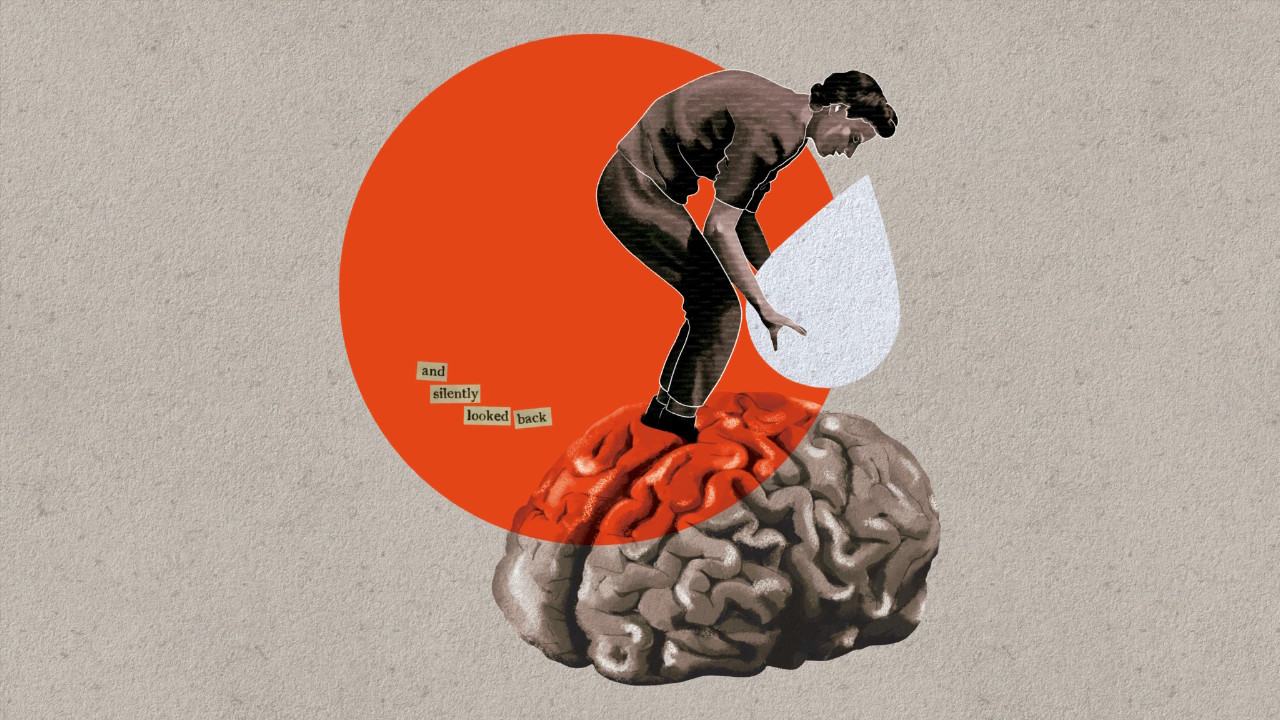
I went into Time Galleon and Tiago Rech’s visual novel, I Did Not Buy This Ticket, newly out on the Nintendo Switch, with no expectations. Indeed, I had only heard about it when the game’s PR team reached out to me with a code, sight-unseen, and recommended I give it a shot. Truth be told, I sat on it for a while; the game has been out on Switch since August 27.
I suppose this is appropriate in keeping with the themes of the game, a surrealist visual novel following the travels of Candelaria, a professional mourner whose chief trick is that she can cry exceptionally convincingly, despite having no emotional connection to the deceased. Candelaria is an avoidant person, as becomes obvious the first time her cell phone rings in her pocket in front of a client, the son of a dead man whose funeral has just been completed. The only options for us to take are to ignore the call and to use it as an excuse to dodge the son’s awkward questions about our life and work. We have another appointment, you see. We would hate to be late.
Candelaria is an insomniac who discovered at some point that taking long overnight bus rides helped her sleep. This becomes another building block in her life as an itinerant mourner: perform sadness and grief, collect the fee, sleep on the bus, rinse and repeat. But on this night, the night of our introduction to Candelaria, she is suddenly in possession of the wrong ticket: a slip of paper for a bus line she’s never seen called the Eigengrau. (For folks who don’t speak German or Dutch, we might simplify this and just call it: the Grey Line.)

The Eigengrau is of course no ordinary bus, and Candelaria’s aloof nature, useful as a shield when talking to bereaving family members at funerals she has no relation to, provides no protection here. Everything is laid bare here, and she must face her own grief and pain before the Grey Line makes her a permanent passenger.
It’s been almost two years since my mom died, and nothing about the grieving period or process has been what I’ve always been told was “normal.” I have had dreams where she woke up the next day after her passing as if nothing had happened and life carried on. I have heard auditory hallucinations of her voice while I was both asleep and awake. I will go days and weeks without thinking about her and then suddenly my mind will be filled with nothing but thoughts and emotions about her, positive and negative memories swirled together like a strange, sweet, toxic soup. In this way, I relate very closely with I Did Not Buy This Ticket, not as a horror text but as a text depicting the surreality, the circular logic of grief.
The other messy thing about death is that there are other people still living for whom you have to account. And this isn’t exactly fair, because in life and death your relationship with someone, even a blood family member, is not contingent necessarily on how the rest of the family/neighborhood/community feels about them. My relationship with my mom was not always sunshine and rainbows. She lived a hard life, and that made her a hard person. I won’t – frankly, can’t – speak to her other relationships but occasionally she and I would come to verbal blows. I went almost a year without talking to her while we were living under the same roof at one point. I never told her about being nonbinary. I haven’t ever told the rest of my family either, before her passing or since. My relationship with my remaining family is cordial, positive, but still—very arm’s length.
And this is how it is for Candelaria as well. Not exactly the same as me, but messy in similar ways. I resonated with her struggles to reconcile with her father, to come to a place of understanding with her brother. I understood why she engaged in self-destructive behavior, like becoming a professional mourner who “doesn’t do it for the money.” There are no easy explanations ready-at-hand. There’s no rationale which fully justifies her actions. But there is understanding, and eventually Candelaria works past the need to be present on the worst day of other people’s lives. I hope I can get there too.

I have always been impressed by video games’ ability, whether they’re big ol’ massive luxurious (and requisitely expensive) productions or tiny, personal and minimalist visual novels like I Did Not Buy This Ticket, to capture these hard-to-express moments. Maybe I’m an easy mark like that, easily made astonished by all art that conveys a personal narrative (I’ve been known to cry while listening to emo albums), but I especially like it when games do it, because it shows that the medium does not have to be impersonal, does not have to be strictly corporate. I Did Not Buy This Ticket is mechanically a pretty standard visual novel, developed in Ren’py, I believe, but the story packs a hefty punch and the art, a sort of blend between dadaist collage and the kind of surreal and mildly-body-horrific imagery I’d expect from a David Lynch film, is simply exceptional. If you haven’t had the occasion to buy This Ticket until now, I’d recommend doing so on Switch. It’s also out on Steam and other consoles as well.
One response to “Review: I Did Not Buy This Ticket”
Hey. Lirio here, the illustrator for I Did Not Buy This Ticket. I rarely write replies to reviews (I’m not the most socially adept person) but you made it really hard not to put into words what I felt reading yours. First of all, thank you. I felt this need in my bones to thank you for sharing your background as a player. I think this was the first time a piece of feedback truly closed the circle between game and player. The rawness of feeling and the way you chose your words genuinely brought me to tears on this end. I hope from the bottom of my heart that grief hurts less over time, even though I know that might not fully be possible.
I hope these words reach you somehow. Take care.