
What we may be witnessing is not just the end of the Cold War, or the passing of a particular period of postwar history, but the end of history as such: that is, the end point of mankind’s ideological evolution and the universalization of Western liberal democracy as the final form of human government.
—Francis Fukuyama, “The End of History?“
Repetition and first time, but also repetition and last time, since the singularity of any first time, makes of it also a last time. Each time it is the event itself, a first time is a last time. Altogether other. Staging for the end of history. Let us call it a hauntology.
—Jacques Derrida, “Spectres of Marx“
Whatever happens has already happened.
—PSEUDOPOD
spoilers, man. you know how I do. For a general explanation of the game’s first few hours and its systems, check this out.

The End of History
At several points throughout my playthrough of Zero Parades: For Dead Spies (Studio ZA/UM, 2026) I found myself cursing my knowledge of history, geopolitics and ideology. Not because Zero Parades is a particularly historically-grounded game, but because it found some way to take the horrors and indignities of the past (and let’s be honest: very much still the present) and depict them in a way that I could not shy away from or rationalize them. From the illicit shock therapies of college-age women in Canada in the 1960s and 70s through to the present-day dismantling and privatization of education all the way down to the totalizing force of US-Western cultural hegemony, I kept running into the consequences of these things. People whose lives had shattered a million times, trying to keep them from shattering once more. Kids dealing with a school system that prioritizes profit over their knowledge and growth. Beautiful cultural tapestries overwritten. My tears felt pathetic. Tears were all I could offer.
Zero Parades is a game that takes seriously the question and thought experiment: “what if Francis Fukuyama’s famous declaration of the end of history had really ended history?” For our purposes, history starts (and ends) with the signing of the Latour-Woolgar Treaty 96 years before the game starts. This agreement between the “Developed World” and the communist powers of the Perpetual Revolution created the conditions for a sort of entropic peace, a world-state where peace was maintained at any cost. We are a spy for the Superbloc, that collective of “Post-Historical Materialist” communist states that operate on the eternal principles of supply, demand and magic, a union that never fell. Opposite us, two eternal imperial enemies also locked in détente: EMTERR, or L’Empire sans Territoire, and the Illuminated Empire of La Luz.
EMTERR is the IMF, WTO, G8/G20, Eurozone and World Bank rolled up into one. They represent the “Developed World,” and as the rat’s nest of neoliberal financial organizations above suggests, their power is mainly in the economic realm. To put it in the words of a character you meet late in-game: unable to access the magic of the People’s Republics, EMTERR found financial instruments instead. One such financial instrument, a “stabilization loan,” was introduced to the small city-state of Portofiro at some point between the declaration of the end of history and the present day, and much like its real-world counterparts, it is a loan that can never, and will never be paid back—debt as subjugation.
Finally, La Luz. The Luzians are the driving force behind both technology and culture in the world, and they have a formidable military to enforce their soft power push. Despite a cultural blockade enforced by EMTERR, everyone is listening to L-pop, watching Luzian cartoons and movies (including a show called “Sixty-Six Wolves,” which can be described as a cross between Utena and Evangelion and which is explicitly spreading Luzian military propaganda), and wearing Luzian clothes. The Luzians are techno-fascists, looking to create a kind of “final society” to match the end of history, and to that end they are also the most aggressive faction, seeking to re-annex “lost” territories of theirs by force in a process they call “Reunión.”
These are, broadly speaking, our players. Portofiro is the stage. Formerly a prison colony belonging to La Luz, briefly under consideration for membership in the Superbloc before its leader, Sweet Nestor, formed a dictatorship based solely on his own whims, and finally an applicant to be part of the “Developed World” under EMTERR—subject to the riptide of every ideological current yet belonging to none—Portofiro is a shambolic tangle of shops, bars, apartments and ruins bearing every scar of history. At every turn, people are simply working to survive. Minor players include the Guardia Municipal, the Carabineros and the Azzurri crime families, but there are plenty of honest thieves, faithful hustlers and streetwise squatters to work with, if you know where to look.
And you did, at one point, know where to look.
Prior to the events of the game, player-character Hershel Wilk, aka CASCADE, was an operant for the Superbloc’s Operant Bureau, referred to frequently as simply the Opera. She was sent to Portofiro in the post-historical year 91 to set up a network of sickos, informants, moles and tech wizards for the Opera to rely on for any actions taken “in-theatre.” And set up she did: a “Whole Sick Crew” consisting of a her then-double HOLOCENE, a crime boss, a cop, a young person whose doctor father was running experiments for EMTERR, an EMTERR accountant, and an audio engineer with a love for my kind of music. Without spoiling anything further here, it all went to shit. Hershel got out, but for her “success” in doing so was rewarded with five years in the place they put washed-up spies: The Freezer.
So why is she—are we—are you—am I back, five years later? And why has everything already gone wrong?

SCENE REPORT: PORTOFIRO
“It’s a bit shit, but it’s alright.”
—Pigeon
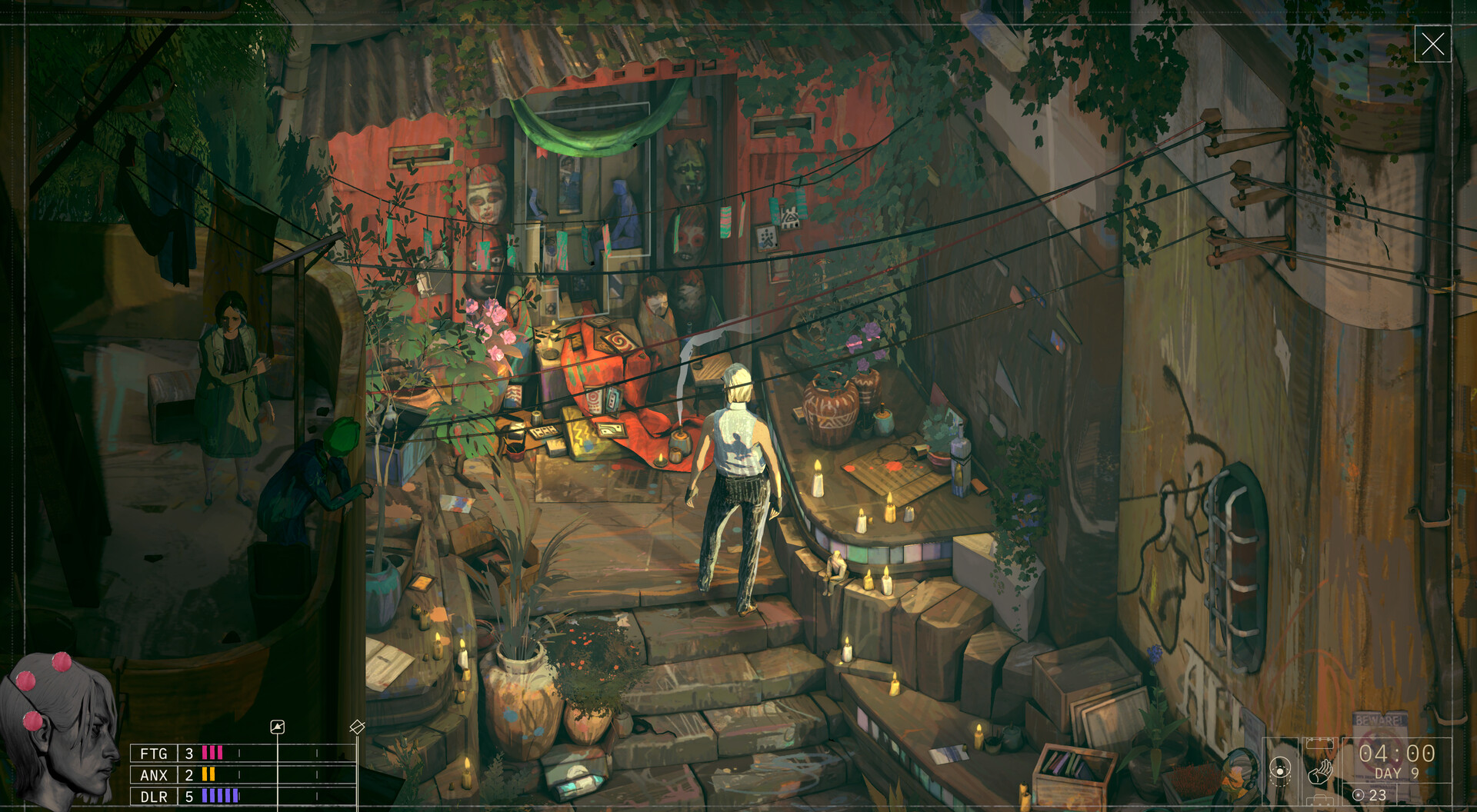
I spent several in-game and real-life days wandering the streets of Portofiro, a consequence of simply playing the game. There is a tram system, and a really easy-to-use fast travel system on the map menu, but I am a firm believer in getting to know the places I visit well enough that I don’t need to look up directions. I have run the length, width and breadth of Portofiro what feels like hundreds of times. And—listen, there likely will never be a video game city that matches the experience of watching Kamurocho change with each successive Yakuza/Like a Dragon title, but outside of that, Portofiro has become my favorite game-city. I can’t bring myself to simply say the clichéd line “it feels real,” but it does feel fully realized.
Dockworkers load and unload crates of product—mostly Luzian, real and bootlegged—from barges; they hang out at the roofless bar adjacent to the Bootleg Bazaar, eating mantis shrimp tostados and drinking cheap beer after a long day. Merchants hawk wares of all sorts and chat with their neighbors and passing customers. From the Backways to Party Alley, people eat, drink and fuck the days and nights away—but sometimes they also search for genuine ways to create their own culture, like Un and Deux, the scumsynth duo exploring dangerous ruins, or Bruce, the proprietor of seemingly the last true Portofiran clothing boutique. But it’s hard to escape the encroachment of the rest of the world. Ads on posters and billboards sell “lifestyles” to passersby, the ever-present crush of L-pop and Luzian cartoons overwrites kids’ and adults’ desires alike for anything local, and the experience of good art is almost completely relegated to memory. Meanwhile, those living in the housing campaign north of the alley seem to mainly keep to themselves and work elsewhere, sometimes distantly elsewhere.
A place is not a place without people. Portofiro is full of people, and my favorite thing to do with them was just simply chat shit. Sure, chatting shit frequently led to spy shit, but just as often, it was just… learning about people’s lives as they lived them. Chatting with Petre the format fetishist about his preferred music format, or Malen the party merchant about the best punk show she ever went to, or Goat Eyes the parking lot plug about the things he loves about home that no tourist board would ever dare tell people about. Having a schnapps in the Fogged Mirror as the bartender reminisces over the Ceramic Panic of 83—a pelota hooligan incident that has resulted in fans of the local Quisach PC getting eternally banned from other pelota stadiums’ bathrooms. Even chatting with a local GM about the hog problem endemic to the area. All of these people, all of these moments and so many more—it all has endeared me to this place in a way very few games have managed to do.
This is not the only dynamic at play among the seedy underbelly of Portofiro, either. There are so many different kinds of pervert in this game that it’s kind of incredible. Some of them are interesting oddities while others veer into despicable territory, but ZA/UM writes them all with profound humanity and uses them to great effect, either by communicating… unique perspectives… or presenting us with interesting puzzles to solve. For instance, it really does help to get on the same page with Petre the Format Fetishist when trying to figure out the properties of the Einzeltone XR, the format of the disc that seemingly zeroed your partner out. In another instance, figuring out what undergirds the fetishes of an EMTERR employee addicted to phone sex leads to a breakthrough in your assignment and includes a really nice time helping the phone sex operator do chores while they tell you about the tricks of their trade. Moments like this abound.
It was about halfway through my playthrough that I realized that I gave a shit about what happened to the people here. That’s always kind of a weird thing to realize when playing a game, because, I mean, it’s obvious: these are not real people, this is not a real place, I am not having real experiences, everything is happening in the magic circle or theatre of the mind or whatever. I am interacting with a set of narrative and mechanical systems, sure. But the writing is so fucking sharp that I am constantly reminded of real conversations I’ve had—and have daily—with my friends, especially as that circle internationalizes. The feeling isn’t cheapened knowing this is just a game or that everyone else is going to experience more-or-less the same dialogue in their playthroughs. Blah, blah, blah, the city is a character, so on and so forth—I stand by what I said in my article from years ago: “by introducing us to the people who make up the heart and lifeblood of [a game town] and entangling us in their lives, we’re given a reason to care.”
memento mori, or: the opera and its consequences
Everything has already gone wrong.
Hershel’s Whole Sick Crew has been scuppered. She got out, but what happened to everyone else? And why is your new double, PSEUDOPOD, lying comatose in an armchair in your safe house at the start of the game? These are questions the game does eventually answer in full and which I won’t spoil, but I did want to hone in on two of Hershel’s companions in particular. At this point you can probably already figure out that I liked the game, so if you don’t want to be lightly spoiled on two principal characters in Zero Parades, skip to the next section or bail out now.
It’s fine, I’ll wait.
Last chance.

boy if you don’t gtfo
…
……
Okay. The spoiler-averse should be gone.
When you finally understand the assignment you’re given, you have to bring together a new sick crew, and it can consist of people Hershel used to run with or all new assets, if you play certain cards right. But first, this means finding them. And finding them means confronting the consequences of Hershel’s asset burn five years prior.
It isn’t pretty.
The first member of the old sick crew I found was Karolina, a young woman living in an abandoned movie theater with her boyfriend Septimus. Septimus doesn’t know you, but he knows of you, and when you turn up looking for her he’s immediately (and probably extremely justifiably) defensive of her. He doesn’t want you to see her, even goes so far as to try to square up to you. Karolina is scarred. She has intense and extensive night terrors, the likes of which Septimus has spent many nights trying to simply make her feel safe. She suffers from massive brain fog, has trouble discerning reality, spends most of her waking hours hooked up to a “bootleg device.” When you help her ground herself and regain some of her memories through the device, you learn the full extent of the truth.
Karolina was tortured. Subject to beatings, mutilations, the kind of electroshock “therapy” you only hear about in books about disaster capitalism. Her torturers tried to reduce her to nothing so that she’d give up everything. Eventually, she did. And she was.
You have an option to indict her on the spot, blame her for everything, but let’s be real, it’s on you. You brought this girl into the world of spycraft and left her hanging out to dry when she needed you the most. She only survived because of a mental technique you taught her, and ever since survival has been a hellish prospect. And here we are, ready to pull her back onstage.
And then there’s Ramses. Rams. Our Rustamian audio engineer, a child of the Dream, a beautiful person from a Beautiful Idea that ended on its own terms when the rest of the world was knocking at the gates. A genuine tech wizard and seemingly one of Hersh’s actual best friends, and when we find him, he is convulsing in a house barge while a demon of capital stands over him, supposedly divining spirits of the free market out of his guttural cries. The truth is much simpler: Rams is epileptic, and he can’t get a prescription for the meds that will save him from a painful, wasting death because, when shit went down five years prior, the same torturers that held K for weeks simply roughed him up for a night, trashed his shit, and then wiped him out from every computer network and ledger of citizenship in the known world. He instantly became an unperson, a stateless refugee, unable to get an ID in Portofiro or anywhere, because… “Turns out presence is not proof of existence,” he says. No ID, no steady job, no prescription. A different, if no less profoundly cruel, hell.
Maybe this makes me a baby but I found myself weeping through these scenes, not because I have some special affinity with them personally or the characters these things are happening to, but because it is all so recognizable. This kind of shit and more is happening as we speak—to Palestinians, to refugees all over Fortress Europa, to undocumented people throughout the so-called US, to queer and trans people, as a matter of course. This is not the special torture of a spy program. It is just… the neoliberal state, doing shit the neoliberal state does.
This, I think, is where Zero Parades is at its most incisive—showing the direct consequences of Hershel’s actions along with all the ways the powers we are in opposition to excel in the art of cruelty and malice. It helps drive the point home that we are ripping the people we choose as our assets away from their lives, or the possibility of living normal ones. And thus we must not choose lightly when the time comes.

A Plan, A Tool, A Crew
If the comparison must be made, then the first few hours, or two in-game days, of Zero Parades admittedly do feel like Disco Elysium. The loop is much the same: walk around by yourself, talk to people, pick up trash, exclusively consume nothing but candy, coffee, alcohol and cigarettes in what I am going to call now and forevermore “girl dinner”—all while trying to figure out what the fuck we’re supposed to be doing, exactly. The end of the demo saw us scrambling into the bed of a 50cc tuk-tuk at the behest of Yana, local bootlegger boss Tempo del Sur’s teenage assistant, and away from Ignatz, the weird motherfucker with a camera who is likely spying for the techno-fascists. But even after we talk to her, it’s kind of up in the air what it is we’re here for, why our double had to be zeroed out, and where to go next.
Personally, I could see some folks maybe having issues with the length this early section extends to, but I do rather enjoy this early period of the game, because it also gives us room and time to learn Hershel’s internal systems with missions and checks that are relatively low-stakes, like “sticking your hand into a garbage dumpster.” It’s good to have some time to figure out when it’s good to exert on checks and when it isn’t, when you need to pound a couple of beers to reduce your anxiety or drink a coffee to lower fatigue, how to obtain medicine that drastically lowers all of your status ailments when you go to sleep, and when to dress differently for the possibility of certain checks when/as they adhere to one of the three major faculties: action, relation and intellect. It’s also important to be able to fail in a low-stakes environment, though the funniest example of an early game over is maybe when you accidentally tip a vending machine over on top of you.
But it’s when the game finally does open up and you get your true assignment that it really starts to shine. You will have to race against the clock, your own internal faculties and stressors, and agents of the enemy to find suitable teammates, build or procure a weapon, and put a plan together to carry your mission out. Along the way, a new question slowly forms. It isn’t “what kind of spy do you want to be?” a la Disco, but rather: will you go on to recommit the errors of the past, or will you change your ways and commit new ones?
Zero Parades is an incredible game. It isn’t perfect; there are a small handful of moments and characters that fell flat for me, quests that didn’t quite make sense or that seemed to end abruptly, messy aspects of the game that stood out to me precisely because the rest of the whole is so good. The game is deeply funny and humanizing around its most serious moments and even as it is highly critical of the neoliberal order. Tendrils of side-stories extend in every direction; you can learn the whole deal about time from a woman stripping copper out of an abandoned rocket silo and choke the life out of an antirealist conspiracy theory-spouting television host. You can mog your way into getting a high end suit at a discount and help another fashion-forward bro get out of a personal high interest loan. You can condition yourself to steal from vending machines and really get to the heart of the “ineffable melancholy” of Luzian pop music—all while technically performing espionage. Even as I was sobbing my way through the final moments of the game and into the credits, I was already planning out future replays. Was my crew composition the best one I could have chosen? Were there things I missed? Are there interactions I could return to that end differently with different faculty strengths and skill levels? Can I give the King of Trade a gun? I’ll let you know what I’ve found later on.
The trick about the end of history isn’t that history has really ended, but that the author—the supposed victor uber alles—has gotten too lazy to keep writing it. They put the pen down for anyone else to pick up, though they think no one else will. And this is how they are taken by surprise by any number of “small” actor, from terrorist cells to counterglobalization protests to the reactionary populist backlash. The truth of it all is that the end of history was simply history unrecognized by the official arbiters, one full of pain, conflict, stress and division. While economic advisors and heads of state ate delicious meals and discussed the steady dismantling and commodification of the world through the enforcement of structural adjustment programs, the world kept trying to live every day the best it could, and when things were no longer tolerable cried out in opposition to the very sensible policies put forward by the most very sensible technocrats to maximize economic output and minimize its input—an age of austerity that made no sense when surrounded by so much… stuff.
We are now reaping the fruits of these awful labors. Fascists are in power across the so-called “free world,” the old rules-based order is collapsing, and new polarities have started to form. Now is the time of monsters, indeed.
With Zero Parades, Studio ZA/UM found the pen put down at the end of history, and with it wrote a eulogy at its resumption.