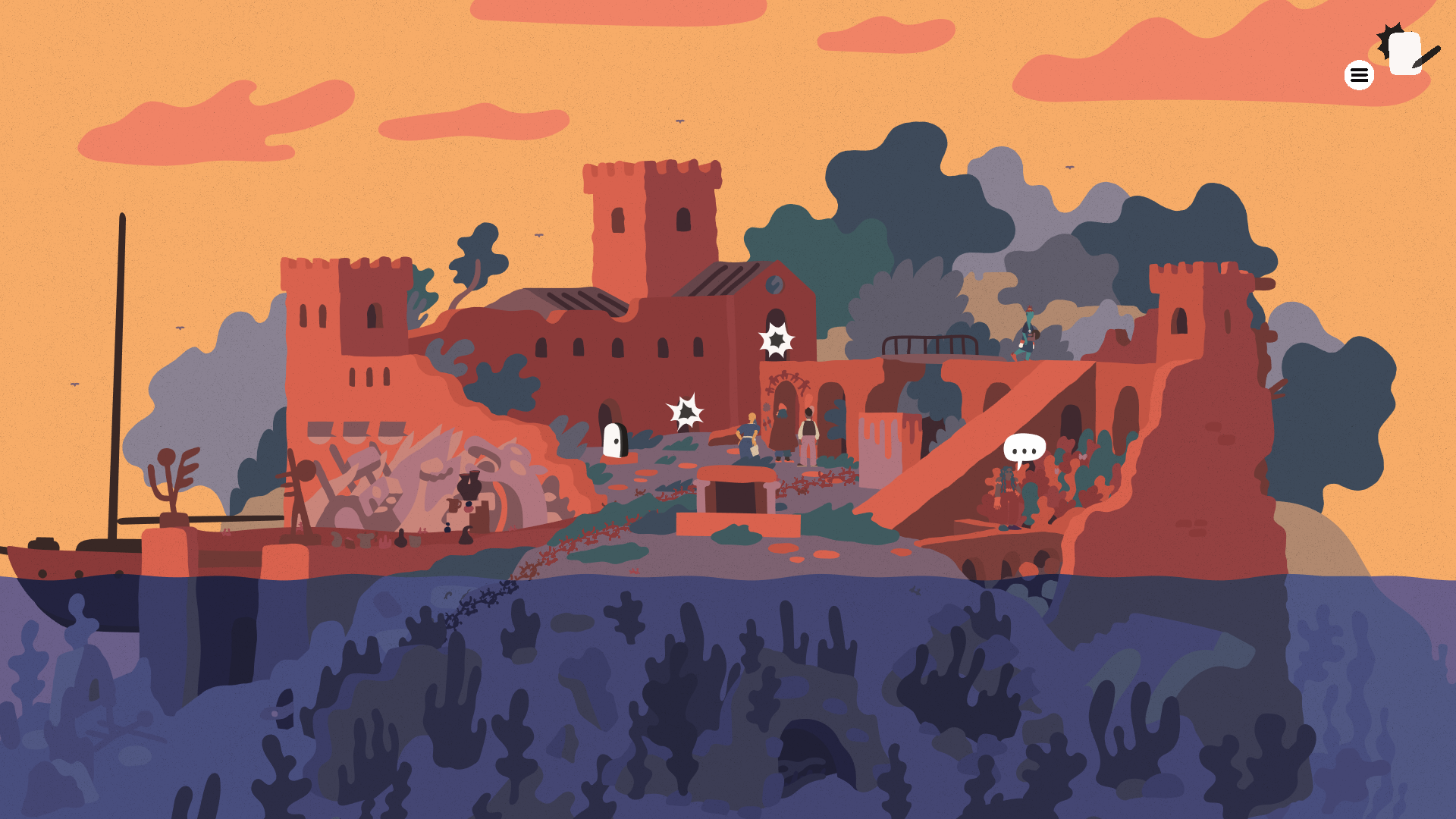
Hey so it turns out trying to play an old video game to write about while also thinking about and getting wrapped up in other discourses is really hard, but I wanted to do my due diligence with Saltsea Chronicles because I enjoyed it immensely.
The deal with Saltsea Chronicles, for the unfamiliar, is pretty simple: you play as the different members of a sailing ship’s crew as they travel around in search for their captain. The game is rooted almost entirely in conversations, and the direction the game goes in changes slightly depending on your choices in those conversations. The actual narrative game design at play here is fascinatingly complex, but that’s the shortest description I can think of. This is, probably to nobody’s surprise, one of the things I really love about Saltsea Chronicles.
Another thing I love is the setting. Technically, there are fourteen different settings, as all the different islands in the Saltsea Archipelago have nominally different cultures and origination points, but taken as a gestalt I think the whole map kinda rips. The entire archipelago is seemingly an experiment in anti- or post-capitalist stateless governance, with shifting rules around trade and commerce, who is allowed in certain communities on a temporary or permanent basis, what kinds of technologies people are permitted to learn about, what kind of rituals and traditions should be passed down, and even how the single shared game across the archipelago, Spoils, might be played from place to place. I hesitate to call what’s going on in Saltsea strictly anarchist, as some of the island communities espouse what I’d deem quasi- or protonationalist tendencies, but it wouldn’t not be accurate to describe the setting as veering towards anarchism either. Even when certain islanders are talking about excluding someone from their communities due to violating core tenets of society, it’s talked about in terms of a kind of soft refusal of association—not prison or even deportation as we understand it.
I love that, much like in Mutazione, the game takes on certain aesthetics of coziness but doesn’t once shy away from difficult subjects, like betrayal or death. The entire game is a meditation on how we might navigate difficulties in our lives, individually and collectively. The crew of De Kelpie are often messy individuals, brought together by their captain, Maja, under the pretense that they were unorthodox members of society and often persecuted for their pursuits of certain knowledge. Murl is an historian interested in what happened before the Flood that created the Archipelago; Stew, the ship’s cook, also has an extensive history with the different cultures; Iris is a young neurodivergent Radder, or radio enthusiast, who knows every language used across the islands; and Molpe, the navigator, stood up for Maja when the latter was a stowaway. This resistance to orthodoxy extends to the new crewmembers they meet: Neshko, the bird-lover with an angry past; Zo, the uncertain Guide; Kittick, the other stowaway; and so on. Everyone has a history, and often that history involves some kind of trauma. The journey is not kind to them, either; it’s almost a certainty that the crew will experience losses of some sort. The game doesn’t skirt around or gloss over this; in the two different death scenarios I encountered (in two different playthroughs), we spent an entire extra chapter engaging with and performing the Archipelago’s specific rituals of mourning. In both instances, death felt sudden and hard to deal with, much like it is in real life. And much like in real life, the time set aside to mourn and grieve did not feel like enough. Not that it ever does.
For a game that is played almost exclusively in conversations, I think my favorite thing about Saltsea is that it is just so goddamn rich. The music, the art, transitions between different times of day, the subtleties in how characters respond to situations with a given set of answers, everything feels so well-considered and dense while never putting me in a spot where I felt detached from the situation at hand. I think the framing of the game as a television show (much in the same way that Mutazione was formulated as a “soap opera”) helps in this regard as well.
I genuinely love this game to bits. I lament that it’s taken two full years to get to it. I wish I had more structured things to say about it, but alas. This is definitely going to be a game I come back to with more intention later.