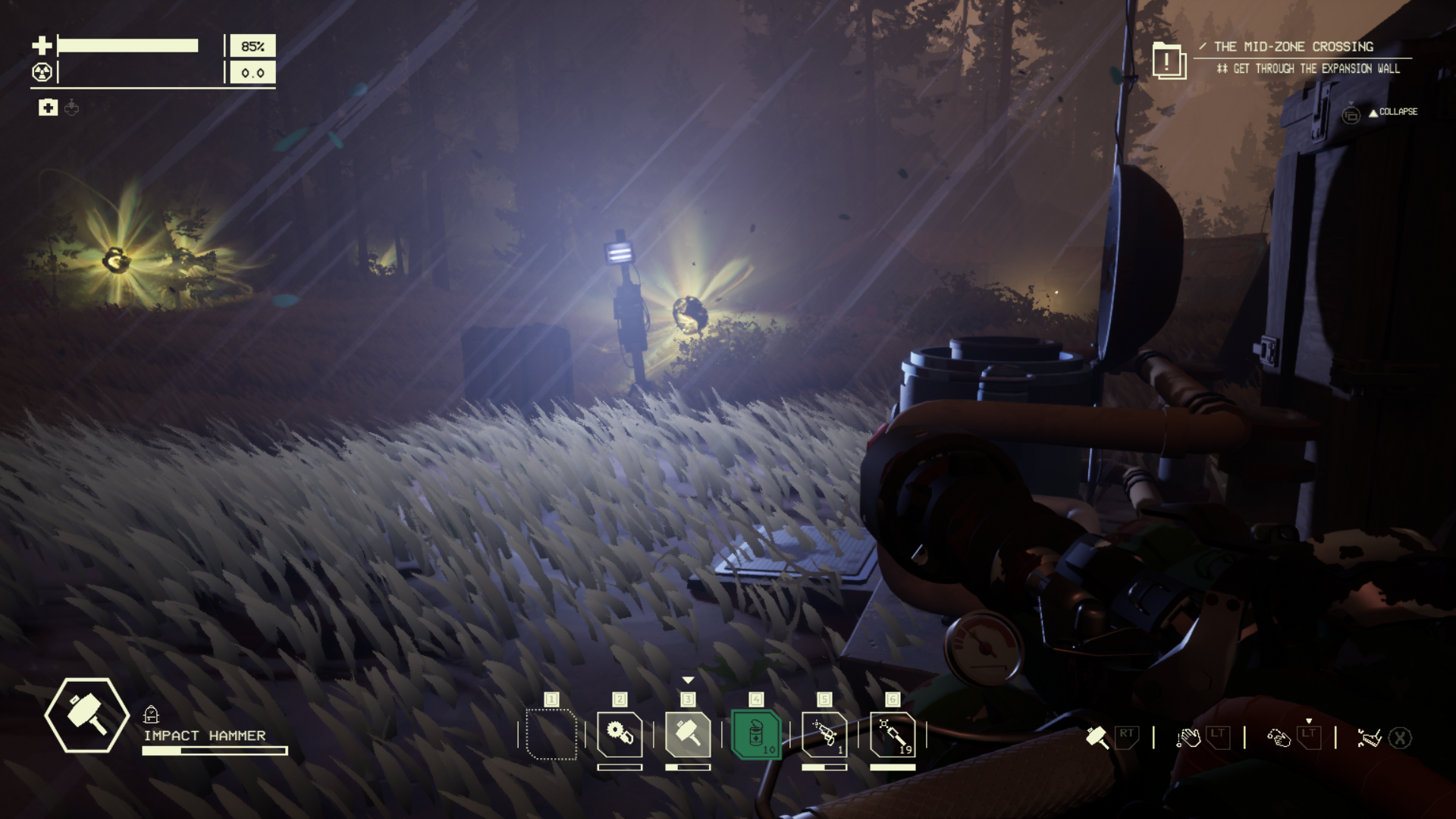
Something flashes in my periphery. Another pneumatic dropbox. My storage containers are getting kind of full, but there’s always a chance something interesting is in one of these dropboxes. I mechanically put my car in park as I’ve done multiple thousands of times before and head over to it. I look inside the tube. Some scrap metal, duct tape, and a note. Paydirt, I thought. It’s the note I’m most interested in, another piece of worldbuilding, lore or other information about the game just sort of lying around out here in the Zone. But the scrap and tape are nice too.
Pacific Drive (Ironwood Studios/Kepler Interactive, 2024) is a survival roguelite set in a fictional Pacific Northwest where a Chernobyl-style exclusion zone has been set up in the Olympic Peninsula following experiments with a novel kind of energy that went horribly wrong. If the atomic age had had consequences for us, this is probably what it would look like. You play as “the Driver,” a nameless, faceless delivery driver who gets pulled into the Olympic Exclusion Zone seemingly at random.
Once inside, you find a beaten-up old station wagon that seemingly miraculously still runs despite having just watched your own car, a robust late-90s delivery van—probably an Econoline or something—get torn to pieces by whatever forces govern the Zone. After meeting a wacky cast of characters over the radio who guide you to safety at an old, empty auto repair shop, you’re promptly thrown back out into the wilderness in order to map the abandoned peninsula—and in so doing, figure out the secrets of your car, the zone itself, and the possibility of a path out.
It’s a run-based game, but aside from a few slight details that shift at random from run to run I would be remiss to call it a true roguelike. Death means your stuff is lost and you’re automatically teleported back to the auto shop’s garage, but you can re-run the route and get most of it back at a tombstone. The physical junctions—what Pacific Drive calls levels—don’t seem to change that much? but the direction you enter and re-enter each zone, as well as what kinds of conditions, resources and anomalies you’ll see, absolutely will.
I’ve played a lot of Pacific Drive since 2024, almost 200 full hours. It’s become a kind of simulated commute game for me, a game I listen to podcasts to while making run after run after run through the Zone after work. I’ve spent hours tooling around in the auto shop, making adjustments to my station wagon, or else sourcing materials for its improvement. Running furtively through the woods to a waypoint I’ve marked on the map where an anchor might be, then sprinting back to the car with anchor in hand as an eruption of anomalies spawn behind me. Whether it’s radiation, acid, electricity, wind or any number of screwball entities, I know the Zone wants to kill me, will kill me if I stay still, so it’s always move move move from one location to the next.
It’s not a flow state. I’m not immersed. I’m engaged, yes, but if I wanted to be immersed in driving I’d just take a drive. Too bad about the price of gas, of course. But when I play Pacific Drive for hours on a Saturday all I really want is time to process things. I want to raid ARDA research trailers and abandoned cabins and rummage through shit. I want to collect notes and poems and chunks of podcast episodes (the game is set in 1998 but they’ve got a whole ass pastiche of Limetown in here, two years before RSS and eight years before “podcasting” was coined). I want to know more about the Zone. I want to know why I keep driving these same roads for the same materials over and over. I want to know what ghosts lie at the Zone’s heart.

Pacific Drive‘s narrative structure depends on you taking multiple drives through the woods of the Zone. The loop goes like this: one of the characters you’ll hear on the radio, Dr. Ophelia Turner, Tobias Barlow, or Dr. Francis Cooke, will do a little exposition dump, usually in the form of an argument between two of the three of them, and then they’ll mark a particular junction you need to visit on your map. If you head to the junction directly, it’ll move the story forward, but at times it does so awkwardly; for example, there’s a moment where Ophelia (nicknamed Oppy by all relevant parties) gets upset at Francis and Tobias for chasing pseudoscience and urban legends, and basically boots them off the radio frequency you’re tuned into. She vows that they’re permanently removed from the mission of getting you out of the Zone. Well, if you move directly to the next story beat, located at a hole in the dividing wall between the Outer and Mid-Zone, Tobias and Francis will re-join your comms and force a truce on Oppy, just like that. You can make these events happen within five or so minutes of each other, but you’re clearly not supposed to. You’re supposed to be exploring. You’re supposed to be taking your time.
This is another reason I hesitate to call this game a roguelike in any capacity. These narrative beats never change, there is no variation in the order of things. You get your car, you find the auto shop, you build an antenna to help plan your route, you get sent through Colossal Cappy, you turn off Outer Zone Stabilizers, you find your way into the Mid-Zone, you take pictures of the “Visions” murals. It’s always that story in that order, with the main variation being, again, how many smaller runs you take in between those beats and what kind of shenanigans each junction wants to throw at you.
I think this is why I find the little bits of collectible lore so special, because they feel truly randomized—you might go several runs without finding a single note, and then all of a sudden every junction you visit has a segment of the podcast and several new pieces of info about the lives of the scientists and residents who called the peninsula home.
The history of the Zone extends back to the 1940s, where instead of the invention of the atomic bomb, Oppy’s discovery of “LIM technology” jumpstarted the nuclear age. For 20 years, she and a cadre of scientists, including Francis and her husband, operated in the Olympic Peninsula with government backing and impunity. In 1961, a lab accident deep in the Zone caused a tremendous gamma ray burst and the induced “Mass Hallucination” of everyone in proximity, prompting the government agency in charge, ARDA, to evacuate the civilian population and establish the Zone proper. ARDA scientists continue to operate there for another 24 years, working to try to draw any remaining innovations from LIM tech that they can while also building successive partition walls to keep out the public. But by 1985, it’s too dangerous to keep living in the Zone. ARDA abandons the area, only working to build the outermost barrier and make the region a true-blue exclusion zone.
But of course we can figure out that their idea that the Zone would remain well-behaved and stay within its physical enclosures was always hopelessly naïve. Hence, by 1998, it would grab random passing delivery drivers like us. Just like in stories like the Southern Reach Tetralogy and S.T.A.L.K.E.R., to say nothing of the stories that inspired them, the Zone is alive and growing and hungry.
The thing about LIM technology is that it caused profound environmental problems from the very beginning, from Ophelia Turner’s first garage experiments with it in the sleepy rural town once known as Sierram. Taking electromagnetic radiation on the radio frequency spectrum and somehow compressing it until it turned into seemingly-boundless energy which could power vehicles, household appliances and any number of other items excited Turner and the other scientists gathered there by ARDA, but it also generated pockets of dimensional instability—at first small enough to be ignored, but eventually these areas of instability started corrupting everything they touched. People caught in the growing unstable areas were, as Tobias puts it so colorfully in the beginning of the game, rendered into “beef in a blender.” Anomalies started to appear. Instability began incorporating itself into the local climate. Conditions increasingly hostile to continued human existence steadily manifested. All of this was happening even before the lab accident in 1961. But everyone involved was propelled by greed and ego to keep inventing, to keep innovating, to find a way to dominate an increasingly ungovernable place.
It ruined people’s lives, it goes without saying. As we travel through the zone we see all sorts of evidence of that. Anti-ARDA graffiti is ubiquitous on buildings across the area. The homes and businesses we loot are full of backpacks which, to us, look like little supply troves—but which actually represent someone’s lost belongings. We’re told to loot to our heart’s content because nobody’s coming back, and there is a deep injustice to that statement that gets glossed over for both expediency’s sake—and survival’s. We’re stuck here. We have to survive long enough to escape. Everything is either instrumental to that goal or it functionally doesn’t exist.
The notes people leave behind are harder to ignore.

In 2024, I wrote about how Pacific Drive‘s gameplay loop felt like storm chasing. It was an incomplete thought, but ultimately one I still stand by. Driving is only half the battle; customizing your car to withstand the constantly-shifting instability-weather, preparing yourself to be able to fix any damage or get around any obstacle to your forward motion is the other half. But there’s storm chasing and then there’s “storm chasing.” The former is programs like SKYWARN and academic tracks at the University of Oklahoma, wandering the Great Plains in mobile research labs, keeping a reasonably safe distance from the beating, unpredictable hearts of the supercells they’re studying, logging and publishing that research to gradually, incrementally improve meteorological models and keep the National Weather Service apprised of dangerous situations. There’s excitement and drama here for sure, but it’s not the main focus.
“Storm chasing” is about the drama. It’s Twister and its sequel. It’s all those Discovery Channel shows featuring Reed Timmer and his so-called “Dominator” SUVs, which I still think the Station Wagon in Pacific Drive is a spiritual cousin to. It’s joyriding with GoPros and DJI 3D cameras lashed to your windows and a “rocket launcher” for sensor drones mounted on your roof. It’s flatbill hat, hell-yeah-brother, yee-yee shit. The thrill and exhilaration of the chase, of putting your shit in harm’s way intentionally for the adrenaline rush, is the point; the research data collected, if any, is secondary.
Most storm chasers end up in the former category, but they were almost unilaterally attracted to it by the latter.
Me? I was disabused of the notion that “storm chasing” was cool in 2013 when Tim Samaras was killed by an unpredictable tornado just about 40 miles west of me. That and I’m out of shape. And my car barely gets up to highway speed without significant protests. But Pacific Drive? That’s right there, baby. That’s that good shit. That gives me that “storm chasing” fix.
One last element of Pacific Drive‘s narrative I feel is relevant to talk about is the provenance of the Station Wagon. Why was it sitting in that garage we stumbled on in the beginning, derelict but otherwise seemingly untouched by the instability? Why and how does it protect us from the forces of the Zone? Why do we feel so compelled to keep driving it?
The answer to all three of these questions is that the car is a “Remnant”—a regular object imbued with a strange ability by the Zone and the unsettling tendency to compel the people who stumble across them to… well, that’s part of the mystery. What your support team tells us is that eventually the Remnant, our Station Wagon, is going to rob us of our agency and sanity entirely, and we are going to be eaten by the Zone. This makes it pretty clear why we have to act with urgency early on. But… hey, fixing the car feels pretty good. And driving it… driving it also feels good… It could be that, as you play, as you get better at fixing things and making it through runs relatively unscathed, as you upgrade the car and the garage more and more, your increasing skill and desire to simply go on another run, and another, and another, is the diegetic sign that the Remnant is working on you.
It could be that.
Or it could be that I find it soothing. I find it easier to process my thoughts after a rough day at work when I play a run, that I find it easier to process podcasts and audiobooks and other media as I wander the Zone. That maybe I’m obsessed with making these runs in the first place because I am using the game as a coping mechanism for… well.
Ultimately the Zone is a place to lose things that are special to you, and get them back in different ways.
I was already playing a lot of Pacific Drive when my mom passed away. She died five or six days after my first post on the game, in fact. Suddenly, I found more in common with drunk, batty Oppy, who lost her husband in the 1961 gamma accident, than with Tobias, Francis or even the blank-slate-on-purpose Driver. Suddenly I felt more of a resonance with all of the notes from the Zone I was collecting that detailed the ways in which regular people were suddenly bereft. I am of course not the first person in the world to lose a parent, but I have been seemingly abnormally lucky that I haven’t lost that many people who were close to me. Death hasn’t crossed my path all that often. And when it finally did, directly, I was left without a roadmap for handling it.
Everything I’ve done in the year since has been a scramble in the eerie darkness, driving at night without headlights, bumping into cast-aside cars, blockades and the occasional side of a house, taking damage to the thing keeping me safe and holding me together. Even as I returned to a pocket of relative stability last fall, I found the ground under my feet continue to shift in strange ways. My Zone is constantly changing. The goal is to survive until I escape or my Remnant, that beat-up old Station Wagon, takes me away one final time.
Until then, I’ll never say no to another run.