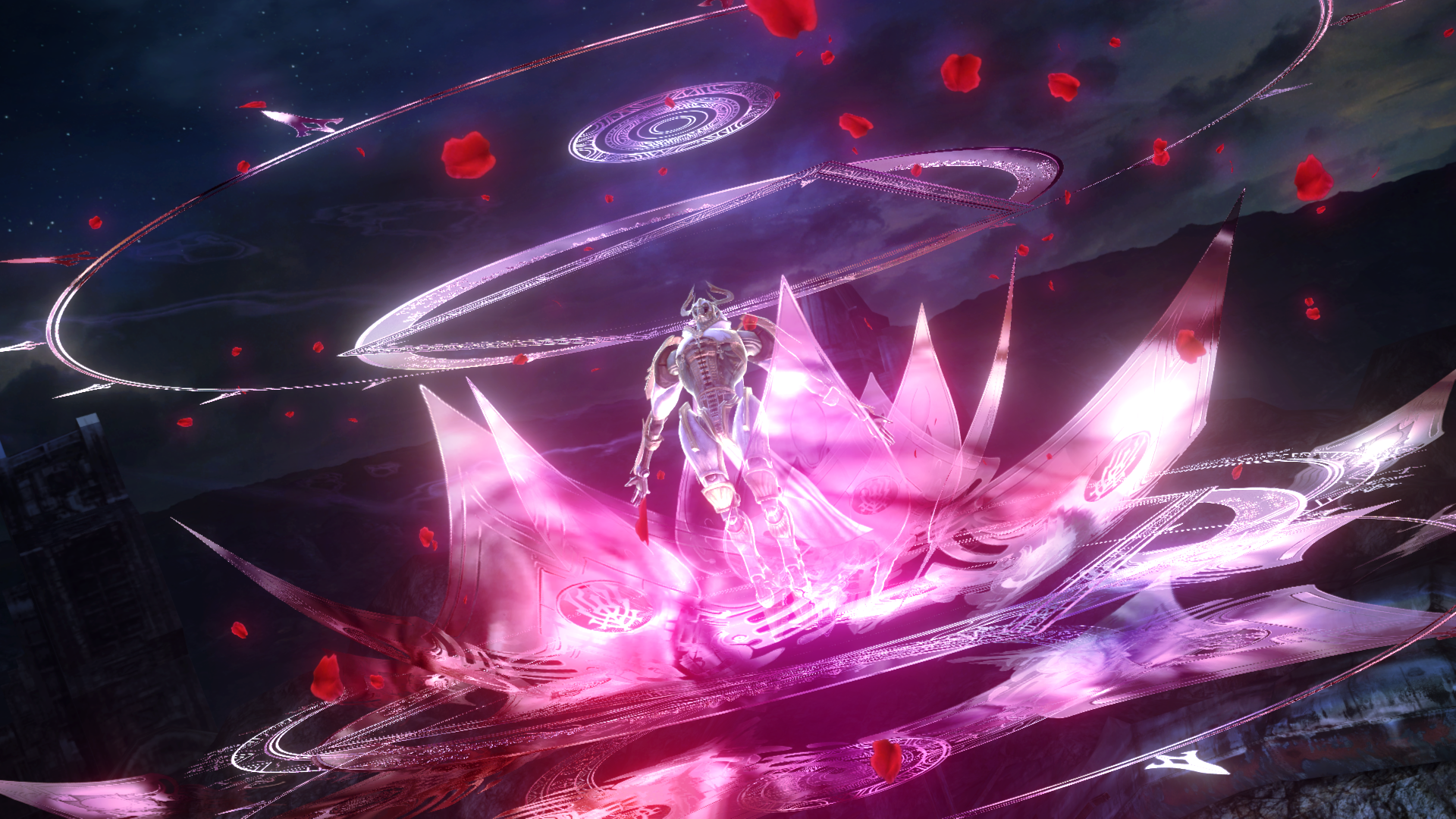
This is my final post on Final Fantasy XIII! I’m finally, irrevocably moving on to its sequels. For real this time. I. I promise.
As I’m sitting in the middle of the final dungeon before facing Barthandelus and Orphan at the very end of Final Fantasy XIII, I think I finally understand the Crystarium perfectly. It’s taken me two full playthroughs to actually get it, and now that I do my thoughts are more conflicted on it than ever. Compared to the more straightforward leveling systems of earlier Final Fantasy games, or even the more complex sphere-grid-style offerings of FFX and FFXII, Final Fantasy XIII’s Crystarium is not a system that lets you pick and choose what to focus on. It is the game’s job board, level progression system, and difficulty check all at once. If you rush through an area or choose not to fight most every enemy you encounter, it’s almost a guarantee that the next dungeon boss or story encounter will leave you frustrated and scrambling for curatives, support-based paradigms, and online guides. It also means that, especially early on, the characters that aren’t in your party during a particular segment (like Snow, Fang, or alternately Sazh/Vanille and Hope/Lightning) won’t get enough Crystarium Points to level themselves up either.
By itself, this insistence on essentially doing what the game says to a T or suffer the consequences would make the Crystarium one of the most demanding progression systems in Final Fantasy. But this is coupled with two more wrinkles of complexity: Primary and secondary role assignments, and Crystarium expansions.
Every character gets three jobs to start. For example, after the first area Lightning’s primary job roles are Commando, Ravager and Medic. Hope, on the other hand, gets Ravager, Synergist and Medic, Snow gets Commando, Ravager and Sentinel, Sazh gets Commando, Ravager, and Synergist, and so on. These are primary roles, and their function is both to teach you how to set up viable paradigm combinations (this is especially important early on when you might only have two characters in a party and few or no overlapping roles), and also how to level the Crystarium up. With each major story encounter the Crystarium expands, adding more that you can potentially do with each job role—but also increasing the amount of Crystarium Points it takes to hit a given node. Nodes are what give you strength, HP, magic power, and crucially, abilities; being able to hit all the nodes before your Crystarium expands usually means you’re powerful enough to face the dungeon boss or story encounter without much of an issue. Luckily, you can usually earn enough Crystarium Points between expansions without grinding too much. Unluckily, skipping a bunch of enemies tends to mean the opposite.
The primary roles are going to carry you all the way to the endgame. They’re going to be the main way you organize your battle team, the basis of how you upgrade your weapons and accessories, and ideally they’re the only roles you focus on leveling up in the Crystarium. The problem is that after Chapter 10, the game opens up in more ways than one. When you reach Gran Pulse your Crystarium expands to give you access to every role, and this is where you might start to go insane trying to optimize before the final areas.

To keep this simple, let’s focus only on our heroine, Lightning. Light is a pretty powerful all-rounder, meaning she’s pretty good at all of her primary roles. Again, those roles are Commando (physical DPS), Ravager (magical DPS/stagger pressure), and Medic (healer). At the beginning of Chapter 11, she gets access to Sentinel (tank), Saboteur (debuffs) and Synergist (buffs). At this point, ideally all of her primary roles will be at very high Level 3 or low Level 4. Gran Pulse is the open world area; defeated enemies here suddenly give you waaaay more Crystarium Points than the stuff you’d just spent 40 hours fighting. They’re also much tougher, meaning your paradigms have to be especially dialed in. (As a side tangent, it’s crucial that you do at least the first 10 or so hunts before leaving the open area, as these hunts usually provide really good rewards and Crystarium Point hauls.)
So what are you supposed to focus on here? Should you try to level everything up at the same time? Should you try to power your new jobs up first so that they can be viable at the end?
In my first playthrough, I didn’t know the answer to this question. I tried leveling every role up equally, one node at a time, across all six roles, resulting in my party generally being pretty underpowered. I’m honestly not sure what I was thinking. The thing about the Crystarium is that it tells you what each node will do, all the way to the end of its current expansion point. I could see when a node gave me more HP, or another ATB bar, or an ability I crucially needed; but instead of just leveling up each role, one role at a time, I made it much harder for myself by insisting only on granular, tiny improvements across the board. I also skipped a bunch of enemies early on, meaning the grind when I got to Gran Pulse was much harder.

In my most recent playthrough the strategy has changed for the better. I only focus on one role at a time, and I level it up completely before moving onto the next role. I fight as many enemies as I can, and dump the points into the Crystarium all at once. To my surprise (but this is because I’m stupid), this didn’t make any of my party members lopsided; typically there were enough enemies to fight without grinding that I was able to keep all three primary roles fully leveled across all characters.
So then what happened when I suddenly had six roles per character to contend with? Did Chapter 11 become an interminable slog, an eternal grindfest where all I did for weeks on end was roam the Archylte Steppe, hunting Behemoth Kings and Megistotherians til I was blue in the face?
Honestly? I ignored the secondary roles entirely and just continued focusing on leveling up the primary ones. It took me 78 hours to level up 332 nodes across those three primary roles (again, just focusing on Lightning). By the time I reached the final nodes on each role it was taking upwards of 18,000 Crystarium Points per node. And the work paid off: Lightning’s base stats were formidable, with around 7900 HP before any bonuses or accessories and a base strength and magic power around 1200. With a fully leveled-up Flamberge (the evolved Blazefire blade that can be turned into an Ultima Weapon), that increases to the 1520s; with just “balanced” accessories I can bump my HP into the 8000s and my magic stat just below 1700.
If I had focused on any of my secondary roles I would’ve been lost in the sauce. Take Sentinel, for example. Just to get it to Role Level 1 (Provoke), I needed to dump 21,000 Crystarium Points into it; in order to reach Role Level 2, I’m going to need an additional 636,000 points—and even then, I still won’t be done leveling up Sentinel. Each successive node after Role Level 2 will cost 30,000 points, and there are 14 of them. The final node, Fringeward, costs 60,000 points by itself. A grand total of 1.137 million points. Multiply that by 3.

“Okay but if you did that grind before the endgame you’d be even more powerful” okay but listen, how about this: I have a life outside of Final Fantasy XIII. And we’re honestly not talking about massive gains here: 650 HP—which doesn’t sound like a bad deal but consider we’re talking about the Tank class—69 strength and 68 magic. These are gains I could get with a good configuration of accessories. Plus, the ability list for Sentinel’s looking kind of anemic here. And I have to stress: this is only achieved after dumping a million points into it.
I could do this kind of analysis for every character and every role but I think you get the point: compared to the primary roles, each secondary role is weaker and offers less in terms of material benefit beyond incremental HP, strength and magic gains. If you want to have a healthy party at the end, one which isn’t wiped out in one hit by Barthandelus and Orphan, focus on the primary roles only, and don’t dump any points into secondary roles til you’re all done with the primary ones.
So I guess the question that I’m left with here is, does this lack of variety make the game boring? What’s the point of a role-playing game if I can’t play the way I want? Was Final Fantasy XIII truly a series design misstep, all corridors and endless tutorials and relentlessly-constrained character classes?

This is certainly a narrative about Final Fantasy XIII that I have heard before. It’s one I can maybe empathize with to a certain degree; compared to Final Fantasy X or FFXII, which both also have large ensemble casts of diverse characters who specialize in certain job roles but also give the player a lot of room to fuck around with more granular aspects of those characters’ identities in combat, the lack of flexibility in FFXIII does feel kind of limiting. But then I think about games that have given me that kind of ultra-desirable, maximal flexibility that gamers always say they crave. I think about Dragon’s Dogma II, another game about resisting fate and breaking the bonds of some divine will, and how that game allows you to be whatever you want whenever you want: all it takes to switch from the Fighter to the Archer or Thief or Mage vocation is a conversation at Vernworth’s Vocation Guild. They’ll even give you a starter set of gear if you’re lacking.
But does it actually, genuinely matter what your vocation is when you slay the dragon on your first cycle, or finally break out of the Pathfinder’s cruel unending tale altogether? When it comes to how characters in the game deal with and refer to you, it’s always “Arisen” or “Sovran,” not your Vocation. The presence of special side quests for certain Vocations doesn’t make this inherently more complex, it just serves to illuminate the true boundaries of the character you play and what you are allowed to be. If the inherent narrative meaninglessness of vocations in Dragon’s Dogma II doesn’t take anything away from it, then I would say the same about the Roles in FFXIII. This is a story about six strangers from different walks of life, brought together by the iron grasp of fate, learning to tell their own story and break out of the cage that has been constructed around them by fickle lesser gods. The roles are part of that cage; learning to break free, to appreciate the story being told without falling back on the insipid demands of contextless “player agency,” is part of our own parallel journey here.
I’m gonna be stoked to truly finish it.

It has been over a year since I started this project and I finally, fully beat Final Fantasy XIII. More vitally, I feel like I finally fully understand Final Fantasy XIII for what it was clearly trying to be, and I can appreciate it for what it is. Figuring out the Crystarium was one of the last puzzle pieces I needed to put the full picture together.
Final Fantasy XIII is a good game. It is sometimes a frustrating game; the fact that I almost doubled my total playtime just fucking around on Archylte Steppe didn’t exactly feel wonderful. It can be at times an exhausting game to play, full of silly proper nouns and chock-full of lore it feels like you were supposed to study up on before pressing start. But its ambitions ultimately don’t outpace its reach; this is not a game that tried and failed to do something interesting with the Final Fantasy formula. It succeeded. It is a game that says, hey: if you pay attention for a little bit, if you take our systems seriously and play with us in our space, we’ll give you something sublime. Its gravity well is hard to escape; that’s why we see echoes of it throughout the most recent games in the series, first as dark mirror and then as straightforward refutation. The first chapter of the new crystal legend said: working together and fighting against oppression, even (and especially) if that oppression is divinely-inspired, is better than giving up. Everything that has come after has been in conversation with it.
I played Final Fantasy XIII again to refamiliarize myself with the game and to finally push this project forward. I feel so full now. I feel like I’ve completed (a part of) my own Focus.
We’ve still got Final Fantasy XIII-2, Lightning Returns: Final Fantasy XIII, and Final Fantasy Type-0 to reckon with. And after that, I figure it’ll be time to go back to FFXV and FFXVI respectively and get down in the dirt with those games. After that? Who knows. I want to look at Get in the Car, Loser as a spiritual successor and most faithful inheritor of the paradigm system; Reynatis, a game written by Kazushige Nojima and composed by Yoko Shimomura, is also on my radar, along with Lost Soul Aside and Forspoken; and I suppose I should probably play Clair Obscur: Expedition 33 to get a handle on how much of FFXIII is in that game.
Beyond all the games I have yet to play there’s one thing I must do now: consolidate my research materials. It’s been a long time coming, and it’s work that has been stymied by other obligations, but now that I’ve gotten past one big game-shaped roadblock it’s time to get serious about the metacriticism I’m trying to do here. It’s not just about the games; it’s also about how they were received and how their memory has endured over time. Thanks for your patience as I navigated a rough patch last year; it’s time to get back to work in earnest.

One response
[…] https://noescapevg.com/part-1-9-the-crystarium/view all tags → […]