Accepting no constraints from without, we countenanced none within ourselves, either, and found that the world opened before us like the petals of a rose.
I have begun replaying Final Fantasy XIII. The brief hiatus I thought I’d be taking starting in May turned into nearly six months of relearning how to live life again. Video games were deprioritized so I could simply get through it: finally cleaning out my old room in the house I’d been living in for almost a decade, downsizing what I owned to a fraction, a small handful of boxes; unpacking in my new home, trying to make it comfortable and livable; reacclimatizing to work and the time after work; getting depressed, getting un-depressed, going outside more, touching grass. Time has simply gone by so quickly. I’m happier these days. I haven’t really touched a video game (save Silksong) in months.
I am eager to get back to writing about games in earnest and so I needed to return to this project, to get back into the thick of it, to reestablish why I wanted to talk about this game in the first place. Final Fantasy XIII as a game, as an experiment, as a specific, watershed moment in time: what it represents, the consequences of its existence. The trajectory of almost two decades’ worth of Final Fantasy sequels was, in my view, affected by FFXIII, and so the whole point of Children of Lightning has been trying to figure out how exactly that happened, and to what extent my hypothesis is actually true in the first place. Maybe it’s all coincidence. But we see Final Fantasy XV and Final Fantasy XVI as its dark mirrors. We see games inspired by it: Get in the Car, Loser!, Lost Soul Aside and Clair Obscur: Expedition 33 (though maybe one could argue that the latter is more influenced by FFX). Echoes of at least one of the Fabula Nova Crystallis games, the one that didn’t make it, Versus XIII, are still present in Kingdom Hearts III and what little we’ve seen of KHIV, in Reynatis, in the Final Fantasy VII Remake games. Crucially we still sometimes collectively use Final Fantasy XIII as shorthand for exceedingly linear games, for games that evidently lose too much of a franchise’s soul in the pursuit of experimentation and iteration, for mid. And that is worth examining, if nothing else is.
So I started another fresh save.
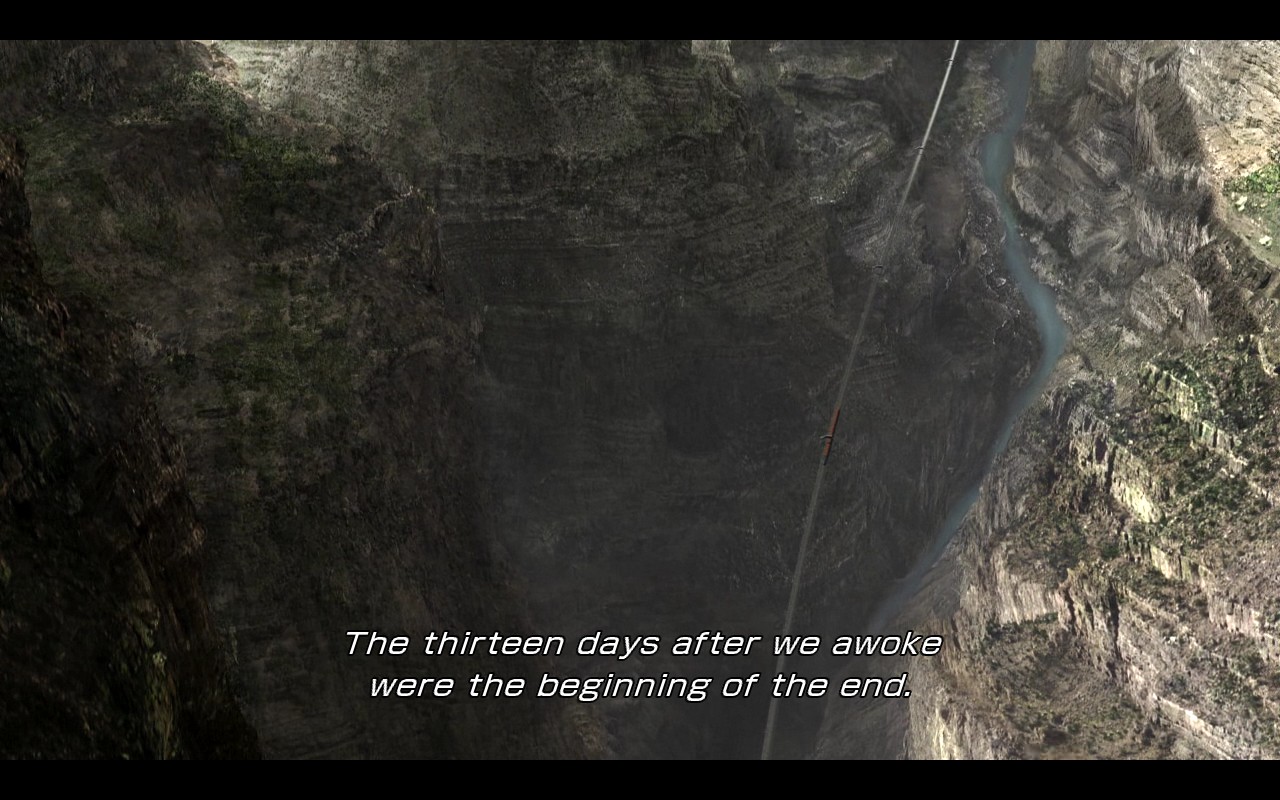
Echoes of Final Fantasy VII abound here. The train journey into the Restricted Zone, the combat with PSICOM troops, Lightning Farron’s immediate apparent skill as a “former Soldier” (and the slight lie that contains), her drive to pursue the Pulse fal’Cie, the contours of a deeply fucked up stratified society forming in front of us within minutes, complete with its own resistance group. NORA. No Obligations, Rules or Authority. A teenager’s conception of anarchism, of freedom, and indeed the de facto leader of NORA, Snow Villiers, appears like he just barely reached his 20s last week. Snow is more of an ideas guy than a bona fide leader. His idea of combat readiness includes hyping his followers up, exhorting them to “be heroes,” and charging headfirst into battle, guns – and fists – blazing. He is, as we’ll see ample evidence of later, kind of stupid. But here and now, his neighborhood watch-turned-ad hoc guerrilla faction is in prime position to do some damage to the Sanctum forces they face. He’s going to free the people marked for purging. Because they are his neighbors, and when the state comes to take your neighbors away, this is what you do.
Lightning and Snow of course are not the only characters we see who we’ll be following for the rest of the game. Sazh Katzroy follows Lightning and fights with her, complaints and misgivings aside; he shares Lightning’s goal of rescuing a family member. Hope Estheim and Oerba dia Vanille, two of our eventual party’s youngest members, are among the hooded prisoners. And so is Hope’s mother, Nora.
There are of course no coincidences. Hope’s mother shares a name with a quasirevolutionary militia for the same reasons that Anakin Skywalker is Darth Vader—they were written that way, to evoke a feeling out of the audience when the reveal occurs. But Nora, the mother, takes a far more meaningful role here than I think anyone gives her credit for.
Nora and Hope are not from Bodhum. They’re from another city in Cocoon, Palumpolum. Hope’s dad is some sort of low-midlevel functionary, it’s never explicitly stated; the insinuation is that they’re a middle-class family and that Nora is essentially a stay-at-home mom. And she and Hope were here on vacation to watch the fireworks that Snow used to propose to Serah, Lightning’s sister. When the Sanctum declared that everyone in Bodhum was to be rounded up and purged, they were caught up in the dragnet as well.
15 minutes ago, Nora was resigned to her fate, unable to see a way out for her or her child. When Snow and his crew show up and ask the Purged if they’re okay, and one of his fellow residents demands to fight alongside him, Nora makes a decision as well. She can let fate swallow her, or she can live for herself and her child and fight back. She stands up, picks up a gun, volunteers. Snow asks: “you sure?” This isn’t in a “Heh, little ladies like you shouldn’t be handling weapons, let the big men fight for you” way. He was reticent to let any of the Purged Bodhum citizens help fight, but made the choice to let them choose and not stand in their way. And so when Nora says, (in)famously, “Moms are tough,” Snow rolls with it.
We know what happens next. Snow asks Nora to help him with a particularly dangerous task in the context of this fight, and it leads to her death. Hope witnesses it; Hope is, as a reminder, a literal child. This is trauma distilled to a knife’s edge, of course. Hope doesn’t understand his mom’s choice. He – and to a certain extent, we – are expected to find the choice Nora made irresponsible, to find Snow’s recklessness not only stupid but kind of despicable, but I want you to think for a second about the rest of this game with me. Think about where this party – Light, Snow, Hope, Sazh, Vanille, and eventually Fang – ends up. Think about the choices they make, and whether or not they also have consequences.
This is what it means to be free. To embrace freedom means to sometimes embrace its consequences. Nora lives on not just because she sacrifices herself to save her child from an unfair and unjust fate, but because she made the choice to be free, defiantly free, in the first place.