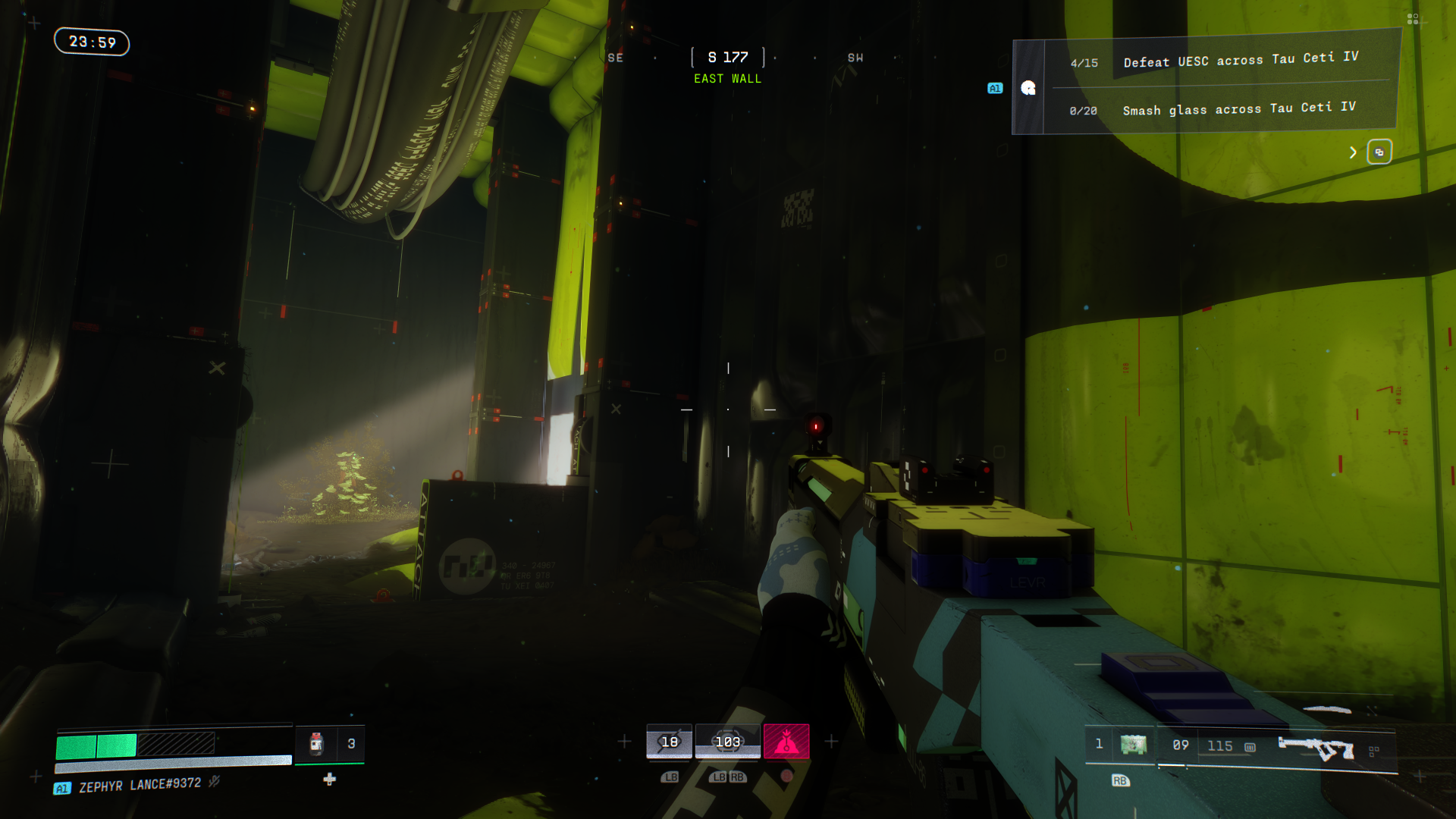
This weekend, after a tumultuous handful of years in development including a very rocky alpha period, hefty allegations of stolen artwork, multiple delays and repeated layoffs, Runners will finally get to play Bungie’s first new title in almost a decade: Marathon. It’s a hybrid PVPVE extraction shooter where players will have to use more than just raw firepower to navigate the hostile world of Tau Ceti IV, traverse the dilapidated ruins of the New Cascadia colony, and avoid both the piercing gaze of the UESC enforcement robots and the treacherous machinations of other Runners in order to complete objectives, collect loot, and successfully teleport off the planet with their riches. Fail and lose everything; succeed and win the favor of the various corporate factions operating in the shadows beyond the Tau Ceti system. Every run, a gamble. Escape will make you god.
Of course, it’s not just players that are gambling on their odds of success with Marathon. Bungie is too. For much of the last 12 years, Bungie has been a single-game studio, working almost exclusively on the Destiny franchise and its myriad expansions, seasonal updates and DLC. During the pandemic period when money seemingly was flowing, Bungie was one of the many studios that took the opportunity to expand, hiring throngs of devs to not just keep Destiny 2 running but also work on other things: Destiny sidequels, entirely new IPs and, of course, what would come to be known as Marathon. After just four years of independence Bungie accepted a $3.7 billion offer from Sony Interactive in 2022, and at least at the time seemed to have immediately become the cornerstone of Sony’s push into live service titles.

Then a few things happened in kind of quick succession.
In March 2023, Destiny 2 launched its Lightfall expansion, an 80s-action-tinged neon-soaked penultimate chapter in the so-called “Light and Dark Saga” that introduced a new location, Neomuna, as well as new characters such as the Cloud Striders Rohan and Nimbus, new player abilities in the Strand subclass, and a fully set stage for the final conflict between the Guardians and their ancient enemy, the Witness. The problem with this expansion is that players didn’t like it. It had the misfortune of coming out immediately after the most highly regarded expansion in Destiny 2 history, The Witch Queen. Players didn’t like the story or the characters; they didn’t like how little momentum the expansion actually seemed to carry; they didn’t like the raid or how easy it was; and for a little while there, they didn’t even like the seasonal content they got after Lightfall. (It didn’t help that fan-favorite actor Lance Reddick tragically passed away right at the beginning of the seasonal arc.) Destiny content creators began crashing out and players stopped playing.
In May 2023, Marathon was announced with a flashy and evocative trailer, along with a vidoc where (now-ex) Game Director Christopher Barrett introduces us to the game by saying, “In Bungie’s next game, we’re combining the rich history of Marathon with a PVP extraction shooter.” People were less than thrilled by this revelation.
In October 2023, Bungie laid off over 100 people, including master composer Michael Salvatori and veteran artist Lorraine McLees. This round of layoffs also came with delays: The Final Shape was pushed to mid-2024 and Marathon itself was pushed to some time in 2025.
In March 2024, Joe Ziegler announced that he’d been working on Marathon as its Game Director for about nine months, or since June 2023. Barrett had been moved to “Executive Creative Director.”
In April 2024, Barrett was fired after an investigation into his misconduct with several women at the studio. This story was reported on in August 2024 by outlets like Bloomberg.
In June 2024, Destiny 2: The Final Shape launches to critical and popular acclaim, following a last-minute pivot by then-director Joe Blackburn to create a bespoke free mini expansion to maintain player retention during the long break called Into The Light.
In August 2024, Bungie fires 17 percent of its workforce—roughly 200 people—moves another 100 people to Sony, and transfers another 75 people or so to a new spinoff studio to develop a new IP under Sony’s supervision.
In September 2024, Sony Interactive Entertainment shut down PVP hero shooter Concord and refunded everyone who had purchased a copy of the game; by October they confirmed that the game was truly dead and that Firewalk Studios, Concord‘s developer consisting of former Bungie creatives, was shuttered alongside it.
In October 2024, director Joe Ziegler posts a video detailing a few aspects of Marathon and announcing plans for a closed test sometime in 2025.
In April 2025, Bungie holds its closed (but not NDA’d) alpha. It doesn’t go well. Another extraction shooter, Arc Raiders, fares much better.
In May 2025, Fern “Antireal” Hook levies extremely credible allegations of art theft at Bungie based on her observations of the closed alpha. Bungie confirms this fully and commits to a complete sweep of the game’s assets to remove any instance of stolen art. Antireal confirms the issue to be resolved by December.
In June 2025, Marathon is delayed indefinitely.
In August 2025, Sony CFO Lin Tao promised that Marathon would release by the end of Sony’s fiscal year, no later than March 31, 2026, and explained that Bungie would be integrating more and more fully into PlayStation Studios.
In January 2026, Highguard, a hero “raid” shooter by Wildlight Studios and financed by Tencent, is announced and released. By mid-February, the studio has fired most of its employees and reportedly less than 20 people are left to continue working on the game.
In February 2026, Sony closes Bluepoint Games after pulling the studio off of a God of War live service title last January.

As all of these things are happening, people—that is, extraction shooter players, Bungie/Destiny fans, Destiny content creators, games media and so on—have been looking at the launch of Marathon with greater and greater trepidation. Is it even going to happen? Bungie and Sony sure seem hellbent on making sure it does—to the point where Destiny 2‘s next small expansion, Shadow and Order, has been delayed by three months. I can only imagine they’re putting all hands on deck to make sure Marathon launches successfully.
And so it is that we have the Server Slam, thusly named because it’s essentially a weekend-long server stress test. Bungie has already warned players to expect bad or dropped connections, long queue times, and all sorts of glitches and bugs. It’s also not a full version of the game, though progression will carry over on March 5. We only get to see the Perimeter and Dire Marsh during the Slam, we can only take on contracts from just a few of the total factions, and we only get to use five of the six main Runner shells, plus the Rook. As it turns out, this is plenty to chew on for a whole weekend given the fickle nature of your typical extraction shooter gameplay loop.
I’ve given the game a few good runs on the Slam’s first day, and right now the question that’s on my mind is this: Right off the bat I love the game’s aesthetic aura. Truly, it has the sauce from that perspective. But codex entries and moments with faction leaders and incidental dialogue heard on-planet have left a bit to be desired. Certain lore tabs seem nonsensically written, and others feel aimless without a firmer narrative structure around them, something that feels notably absent from my wanderings around the New Cascadia Colony. Doesn’t Marathon also have the juice, or is it narratively juiceless?

Part of the problem here comes in the form of high expectations. Bungie has always been considered a sort of narrative powerhouse for the work they’ve done on Halo and Destiny, but Marathon is like the incitation of much deeper, much older magic: it was the second FPS Bungie made (after Pathways Into Darkness) for Apple’s Macintosh computer systems in 1994. The story to come out of that first Marathon trilogy is highly convoluted and intricate, involving multiple dimensions and time travel, marauding alien empires, and rampant artificial intelligences seeking ultimate power.
Marathon (1994) starts onboard the titular colony ship as it is being invaded by hordes of Pfhor, S’pht, Hulks and Wasps. The story is told primarily via data terminal as you make progress through the maze of the ship; the writing feels much more connected to the world around the player. Fans of the original Marathon trilogy have spent the better part of 30 years poring over the data terminal texts and every other written aspect of the games, crafting theories and having heated debates over the meaning(s) of particular moments in the broader context of the series. At least for now, none of the writing in Marathon (2026) seems to be evocative, emotionally, of those earlier days, to say nothing of the ways in which they (don’t even) seemingly materially connect with each other.
Another problem is that your main interactions with the heads of each faction are evocative of a much more recent Bungie narrative staple: the weekly wizard chore hologram chat. One of the biggest complaints about Destiny 2‘s story prior to the past year[1]They changed some stuff with post-The Final Shape content, and so now things are much more in flux than they were for the bulk of Destiny‘s existence was always that the only way the game’s supporting cast ever interacted with us was through radio chatter or via mostly static holograms whenever new weekly quests became available. These modes of communication have become emblematic of the constantly-running content treadmill that Bungie shaped Destiny 2 into. In Marathon, the faction heads meet with you and hand out contracts in very nearly the same way, though of course now it’s got a fancy name: “neural interfacing.” Your AI handler, ONI, also primarily talks to you through these modes.
Ultimately, though, it’s still too early to tell. What we have on offer in the Server Slam right now is a selective portion of what is hopefully a much beefier experience. It is easy to tell that the game has the sauce just by looking at it; the hurricane of corporate cyberpunk aesthetics hits you in the face from the get-go and you are never not surrounded by it. Every faction introduction is stylish as fuck, the environmental storytelling is already quite something (even if it’s not clear where the story is going yet), and I am a huge fan of the runner etherstep (Marathon‘s name for teleportation) loading screens, all covered in moths and such before dropping me into an almost-ASCII-like overhead representation of the map.
Does it have the juice, though? Is the game’s narrative scaffolding strong enough to hold all these vibes up? Don’t know. Probably won’t find out until after the game actually comes out. I genuinely hope so.
References
| ↑1 | They changed some stuff with post-The Final Shape content, and so now things are much more in flux than they were for the bulk of Destiny‘s existence |
|---|
Leave a Reply