I don’t know what it was about the height of the pandemic that caused everyone to suddenly get invested in the culinary arts, but it was around the time that we were all sheltering in place that I started watching cooking shows in earnest. Before the pandemic I dabbled, of course; the Bon Appetit channel was a favorite of mine until it turned out that Condé Nast was being predictably Condé Nast about paying people, and occasional recipes on Binging With Babishcaught my eye from time to time. But at the height of when there was nothing else to do and nowhere to go, that’s when I started watching long, drawn-out series on the history of pizza in New York and elsewhere, it’s when I first became acquainted with the work of “Burger Scholar”-turned-restaurateur George Motz, and it’s when I finally sat down and really absorbed the various food/travel hybrid shows of Anthony Bourdain. It was in this work by these chefs and writers that I learned a well-kept open secret: food is the true heart of a place and the people who live there.
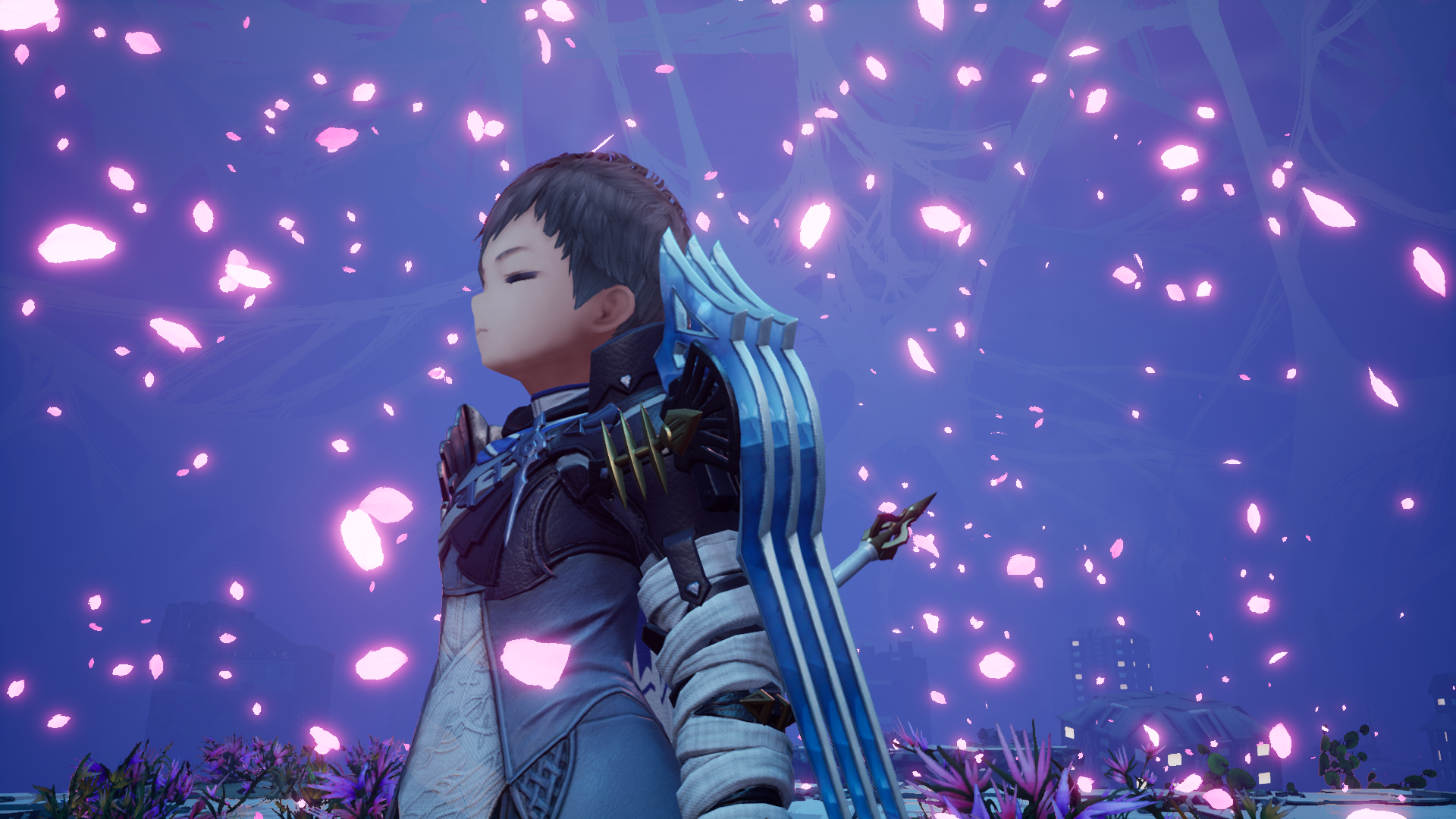
This might sound like a strange way to start off a JRPG review, especially for a game like Harvestella (Live Wire/Square Enix, 2022). You might expect such a piece to start by describing the setting or outlining the plot or at the very least catching readers up to speed with what kind of JRPG it is. And I might throw out various genre descriptors and assorted other signifiers to help orient you: “it’s a farming life sim,” “it’s an action RPG,” “it’s heavily inspired by Nier Automata and ATLUS games,” “the developers who made this helped on Another Eden and went on to make the Ender Lilies/Magnoliagames,” and so on. And that would all probably help describe the game, but it wouldn’t get at the root of it. Because ultimately, food is at the heart of Harvestella, too.

Everything I said about the game is true, by the way. It’s loaded with a lot of familiar touchstones for anyone who has played JRPGs or life sims since 2017. And it’s a very economical game, taking place for the most part in a tiny world with a grand total of four towns (and your house); the game doesn’t really expand until later, and even when it does it’s still mostly you bopping between those four towns and the tiny interstitial wild areas between them. There’s a character creator but the options are fairly limited; to Harvestella‘s credit, you do get to self-ID as nonbinary, though the pronouns are stuck on they/them if you’ve got neopronouns, and you can pair any voice type with any body type. Not perfect, but pretty good!
But food is the primary motivator behind most things in the game. And the first thing you learn: if you don’t work, you don’t eat. Whether you do sidequests which reward you with currency (grilla) and supplies, raise livestock to lay eggs and produce milk, or you grow a seasonal farm to harvest produce for sale and consumption, there are few idle days to be had in Harvestella. Indeed, to drive this point home, there is a very strict in-game day-night cycle; when you’re on the farm or in a town, ten minutes pass every 10 or so seconds. When you’re out on the world map? Time passes much quicker. You’ve got from 6:00 AM to shortly after midnight to complete all of your daily chores and return home to bed; if you’re caught out after midnight or you push yourself too hard in battle, you collapse in the field and get teleported home, incurring steadily-increasing doctor’s fees for your troubles.
Food is how you maintain your health throughout the game; there are no curatives and no healing classes. While you’re in a dungeon or a wild area, you don’t regenerate health on your own; and on top of that, while you’re anywhere, you don’t regenerate stamina without something to eat. To make meals, you need recipes, otherwise you’re going to be stuck eating nothing but ingredients that barely allow you to regain health or stamina; to get recipes, you’ve gotta trade some of that sweet cash you made hunting, farming or doing stuff for people. Each town has its own set of recipes, seed stock and special ingredients—and every inn, far from being a place for you to rest on the road, has a staff member there waiting for you to make some of their region’s specialty dishes.

Of course, just making food mechanically necessary doesn’t actually help us get at the heart of why food is so important in Harvestella. There are checkpoints scattered throughout the world and in dungeons called “Motus Monolites,” and in dungeons these Monolites become sites of respite, a little bit like bonfires in a Souls game or safe rooms in Persona 5 palaces. You can share meals with your party members at these Monolites, creating moments for edifying bits of dialogue between characters in addition to replenishing your HP and stamina fully. Making different kinds of meals to draw out new insights into party members is a really interesting and elegant way to add more opportunities for you to find character growth as the story progresses.
The thing about it is, you can’t just make every food from every city all at once, because on the next level of complexity up, the game’s major time metric is the passing of seasons. Each season is roughly a month long, and the boundary between each season is a day of death, or “Quietus,” that resets your farm and kills any crops left in your fields. The first day of the month, then, is spent planting any seasonally-appropriate seeds, or going to one of the cities’ general stores to buy new recipes and seasonal seed stock. Patience is the true solution to all the game’s puzzles and locked doors; all you can do is live day-to-day and figure things out as they come to you.
I really like this insistence on waiting, because it forces me to engage with the game’s systems as intended. Can’t progress a social link with your favorite character? Well, you still gotta eat. Your livestock still needs feeding and pets. You still have to maintain your gardens. Tomorrow will come and there will be more to do. You can’t get through a whole dungeon first try in a single day; don’t push yourself too hard. The unfortunate bit here is that eventually you will run out of stuff to do, whether that’s sidequests, social links, collecting info on major dungeon bosses called FEARs, finding ingredients for recipes, and so on. Eventually you will have to reckon with the story.

At the beginning I said that Harvestella is clearly heavily inspired by Nier, specifically Automata. Unfortunately I think that undersells the extent to which Harvestella is indebted to Nier entirely. Everything from the way characters are designed to the music to the very setting and story are remarkably similar to Nier and its 2017 sequel. This is a game, no way around talking about this, set in a post-post-apocalypse, where humanity has regressed from the height of scientific achievement amidst an unstoppable climate disaster to a profoundly pastoral, and almost completely ignorant, existence. On the periphery, mysterious artificial beings called Omens—just a hair’s breadth from androids, if we’re being honest—seem to be running the show, performing maintenance on the environment and trying to keep people from wandering into danger. You sort of just appear in this world—on Quietus, no less—and all sorts of upheaval follows inadvertently in your wake.
The game, then, is about figuring out what happened here. Unwrapping the mysteries of the world one layer at a time: learning what the giant crystals that control the seasons are really for, figuring out the Omens’ purpose, even discovering what planet we’re supposed to be on. All learned at a slow, steady pace, over the course of days, if not months. And in between, we’re supposed to learn about our companions and the people they live with—from the doctor in Lethe Village, determined to cure the incurable, to the conflicted young guardian of Nemea Town and the singer with a captivating voice at the bar on Shattolla Beach (and beyond). At times, the references and allusions to games that came before Harvestella can be a little much, but just because the game uses strikingly familiar ingredients doesn’t mean it can’t cook into its own meal worth eating. And I think by and large the team at Live Wire do manage to pull that off.

Breaking away from the (tortured?) food analogy for a moment, I can’t heap enough praise on the game’s writing. Not everything in Harvestella works always, but I have frequently been astonished by everything from really smart character barks to the entirety of several multi-step sidequests. Particularly, I am taken aback—positively!—by the way this game handles childhood, healthy (and unhealthy) relationships, and the process of working through traumas. The game unwaveringly treats kids like people, and takes their worries and opinions as seriously as it does any of the adults’ various problems. Even in moments where there is conflict between a child and their parent or some other adult figure in their lives, the game never defers to the adults by default, nor seeks to punish the kids for their actions. This is genuinely wild to me. I haven’t really seen this before in a game, at least not to this extent (and I’m willing to admit that might just be my lack of experience with such games, but even still! I think Harvestella is doing some special shit here).
Making food, like making a game, is a process that takes time and skill to perfect. Even if you use the most basic, most recognizable ingredients, getting a meal right is not guaranteed; one wrong move, a moment of lapsed attention, and everything you work for might be ruined. The ingredients in Harvestella are eminently familiar, and if they had been implemented improperly or without care, we might be talking about this game as a failed Nier clone with Rune Factory or Story of Seasons stapled to its back. Instead we get something delicious: a game that inspires players to slow down, learn about the world they’re visiting, make a tasty homegrown meal, and revel in the comforts of a compelling story well-told.

Coda: The Difficulty of Endings
I thought I would be done with Harvestella by the time I hit “publish” on this review. As it stands, I am saved at the final boss of the game (allegedly), about six or so hours after I expected to be finished. It is late in the evening; I won’t have time to play this tomorrow. I want to finish it, but Harvestella has a familiar problem with endings that many other games, certainly not just JRPGs, seem to have: it just doesn’t seem to know when to quit.
To further torture the food analogy, it’s like when you slow-cook a pot roast: leaving it in the crockpot for just the recommended amount of time is liable to leave everything hard and flavorless. Maybe you leave it in just a little bit longer and let the juices seep into every carrot and potato and onion; maybe you leave everything in for far too long, and all the ingredients are as like mush. Timing is just as much of a factor as the ingredients you use and in what order you cook them, and I wish I could say something else here, but I think the repeated false endings and labyrinthine final dungeons of Harvestella do more harm than good to the overall recipe.
I am going to try my best to reach the very end of the game. But if I don’t, well.
I think I’ll have to be satisfied with a delicious, if unfinished, meal.
(update: I did finally beat it!)

Leave a Reply