
For the first time in my games critic career I have to put a possible conflict of interest disclaimer here before the rest of the post: I received early access to the Steam Next Fest demo code for Zero Parades: For Dead Spies. I am also friends with a worker at ZA/UM. This friendship has likely unavoidably colored my thoughts about the studio and everything that has gone on around it since 2022 or so. That said, in this impressions piece I still intend to come at the game with a critical perspective and do my due diligence to honestly impart to you how I feel about the demo. If that isn’t sufficient for you to trust my writing, fair enough. There are other write-ups out there, and you should check them out instead.
You are not what you own!
You are not what you own!
You are not what you own!
You are not what you own!
We owe you nothing!
You have no control!

You wake up in a bathroom in Zero Parades: For Dead Spies. The obvious comparison is going to be to Disco Elysium‘s beginning moments, where amnesiac alcoholic detective Harry DuBois regains consciousness on the floor of a desecrated hostel room in the rathole slum setting of Martenaise, a run-down dock district of the Revachol Zone of Control. A former communist utopia destroyed by the rest of the world and forced to adhere to global capitalism and neoliberal politics, never fully rebuilt to remind the population that there is a price for everything, including liberation. But Zero Parades doesn’t let you stew in bewilderment. Operant Bureau agent Hershel Wilk, codename CASCADE, knows where she is and what she’s doing in the tiny city-state of Portofiro. She was supposed to meet with her double, another operant codenamed Pseudopod, but he’s been zeroed out—driven into a state of catatonia by something and rendered inoperant.
Indeed, much unlike Disco Elysium, you are given essentially everything about Hershel’s backstory up front. Well, presumably. In the Opera—the field of espionage that sits over top of Portofiro’s geography like a Borgesian 1:1 map—it’s probably a safer bet to assume that everything we read is a lie from the get-go. But the basic shit, which has already been revealed by ZA/UM well before the demo, is this: you were a top spy a few years ago, and you had a beloved crew of seven assets—”The Whole Sick Crew”—that you ran with before something went wrong and forced you to flee Portofiro, burning them all in the process. For your troubles you were sent to work at an outpost called “the Freezer,” where you were kept until the present day and your inexplicable recall into active service. But because your double was zeroed-out on arrival, your mission is already compromised and—according to your handler—it’s back to the Freezer you go, double-quick.

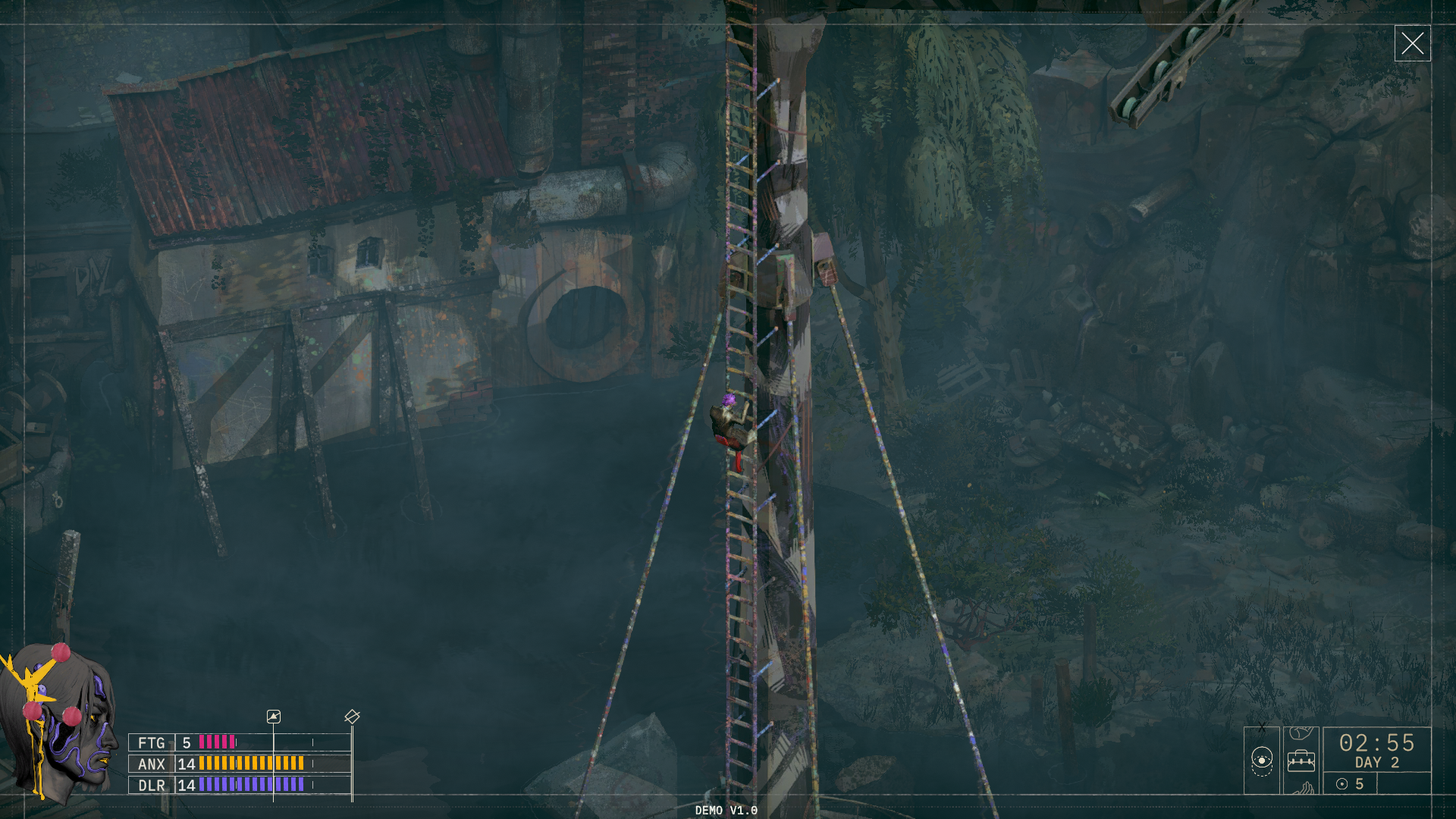
Throughout this opening scene, you are taught how the game understands, keeps track of and penalizes your physical and mental health. You have three faculties: Faculty of Action, Faculty of Relation and Faculty of Intellect, similar to the four attributes at Disco‘s core, or the S.P.E.C.I.A.L. system, or D&D stats. You get it. But each of these broader faculties is tied to an ailment: Action is tied to Fatigue; Relation is tied to Anxiety; Intellect is tied to delirium. Ten points or less in these ailments makes it harder to “exert” yourself, that is, add an extra dice to your white and red skill checks. Eleven points or more makes a given ailment active, and reaching 20 points or higher in an ailment permanently reduces one of your Faculty skills, like Shadowplay (stealth) for Action, Statehood (ideology) for Relation and Poetics for Intellect. Anyway, as you assess your inoperant partner and phone your handler, your anxiety skyrockets, and it can even be pushed over the breaking point for the first time before you ever leave the room.
And like, yeah man. I get it. You spend years in a hole unable to do anything, stewing in the trauma of a botched job laid directly at your feet, the unshakable knowledge that you betrayed your loved ones, that there is nothing you can do to redeem yourself in the eyes of god or the state, and then suddenly the status quo changes, you think you might finally get the chance to make things right after all these years, at the very least you finally get some freedom of movement again, and it’s all immediately fucked—turbofucked, even—the moment boots hit the ground. There is the panic of failure, of repeating the past, of being forced to return to captivity all at the heart of that anxiety. So you lie to your handler, or you disregard a direct order, and you do what you do best: you put your decades of spycraft to work to figure out what the fuck happened to your double and maybe just once stop history from repeating itself.

I have played the Zero Parades demo to completion twice now, taking different preset classes each time. Most of the changes between the presets were subtle; checks I passed with ease I now needed to exert for, or risk failing. I missed conversations and explorable areas in my first go, so I spent more of my second playthrough working Portofiro over with a fine-toothed comb. Some percentage of players won’t be able to help seeing anything but Revachol in the bootleg bazaar or party alley. The melancholy that shot through Disco Elysium is also present here, unavoidable for the most part. Portofiro is also a place trapped between Great Powers. There’s EMTERR, the world bank, well-known for bringing aggressively neoliberal “stabilization” to “undeveloped” areas of the world. Then there’s La Luz, a technofascist military superpower with a monopoly on pop culture. And then, of course, there is the miracle of post-historical materialism and home to the Operant Bureau, the indefatigably communist Superbloc. And it must be stressed: even though apparently in the full game Portofiro makes the entire playable space in Revachol look like a street corner, in the grand scheme of the world it’s really goddamn fucking tiny.
Rather be forgotten than remembered for giving in!
Rather be forgotten than remembered for giving in!
Rather be forgotten than remembered for giving in!
Rather be forgotten than remembered for giving in!We’re all tired of dying so sick of not trying!
Scared that we might fail we’ll accomplish nothing!

But Portofiro does feel different to Revachol. There’s still so much life here, despite EMTERR’s attempts at “stabilization.” You talk to some kids who are glued to a TV set in the bazaar, watching a Luzian cartoon called Sixty-Six Wolves (which is basically Utena and Evangelion but everything’s wolves and full of explicit techno-fash propaganda), and they explain to you how since their schools privatized they’re stuck on a two week on, two week off schedule. They’re currently stuck in the two week off schedule, while one of their friends’ schools just got shut down for good. And there’s a party clothes vendor whose dad got hopped up on the conspiracy theories put forward by a character I can only describe as “Alex Jones if he was Subcomandante Marcos,” and has suddenly gone missing. And there’s Petre, the Format Fetishist, an Adorno figure who sells music but hates every genre and format but one. And so many more interactions and observations that I think are better for you to see for yourself when the demo launches in two days. Basically, much like Revachol, Portofiro is a place I want to keep exploring for as long as it will give me its secrets, and this demo gives us so much to explore just to begin with.
I genuinely have been so taken by Hershel’s characterization and the writing around her interactions with the world. I find it fascinating that one of her most apparent faculty skills at the outset of the game is Statehood, no matter how strong or weak it is—the implication being that the long years in the relative isolation of the Freezer must have compelled her to absorb a lot of Superbloc propaganda. I find it equally fascinating that when presented with an opportunity to warn the kids watching the fascist cartoon from La Luz, another voice in her head suggested that she cool it on lecturing them—at least for now. The orbitals, another transplant from Disco Elysium, range from interesting observations about the world to pointers guiding Hershel towards her next objectives, whatever those might be. For a demo whose runtime only extends to about three hours if you take things slow, there’s so much to sit with.

Of course, a demo is a strange object. It’s not the full game. What the full game actually is could change dramatically between now and its eventual launch. I initially didn’t like the voice actress doing the narration, but her work has steadily grown on me and I don’t mind it so much. I also noticed some performance issues as the game loaded larger areas, and there’s some awkwardness with the walk/run cycle from time to time. Nothing felt especially broken except for possibly the night cycle, which awkwardly just shut down an interaction I was in the middle of. All of this is to say: if the demo is any indication, Zero Parades: For Dead Spies and all the rest might shape up to be a really fucking good game when it launches.
But Is It Disco Elysium 2: Plagiarist’s Boogaloo?
The pall hanging over this whole post has been this question. Here I have to remind you again: a friend of mine works at ZA/UM. My friendship with them has inherently colored my opinion of everything that has gone on at the studio. I have a strong suspicion that nothing I say here is going to change anyone’s mind, and I have some good news: there are certainly posts about Zero Parades and its demo that take the tack that the game is a pale imitation of its predecessor and that nothing it could ever do will erase the great historical atrocity that was Robert Kurvitz et. al getting shitcanned; if you want to read one of those posts and feel reaffirmed in your own convictions, please do so. That’s none of my business. I can only have the opinion I have.
Zero Parades: For Dead Spies, bluntly, is not Disco Elysium 2. It’s not (just) that it’s set in a different world with different metaphysics and a nearly-opposite protagonist to Harry; it’s also incisive writing that is pointed at specific historical and ideological tendencies, external to the kind of copspy Hershel is meant to become, in a different direction from where Disco went. Things feel more fleshed out, less purpose-built just for meming. A lot of the frame prose—narration of what’s happening to and around Hershel outside of dialogue and the like—is much more brusque and direct, rather than explicitly flowery and poetic—which doesn’t reduce its frequent beauty. Rather than the mark of a decline in writing quality this seems to me to be in keeping with the kind of literary genre Zero Parades might sit in if it were a book: the spy novel rather than the pulp detective novel. If you enjoy Disco Elysium, it’s maybe an open question as to whether Zero Parades will be up your alley, but what I can tell you is that there is theoretically enough room on the metaphorical bookshelf for both of them. Zero Parades does not replace Disco Elysium, it doesn’t supplant it, it’s not trying to shit on its predecessor for the sake of historical (studio) revisionism, it is fully its own thing, made by different people.

Beyond my (surely disqualifyingly problematic) friendship, I am legitimately frustrated with the way I see people talking about this game and its studio, when at the same time they take ad money from Microsoft and gush about Bethesda games and gloss over the decades of abuses at studios like Ubisoft and Rockstar in anticipation for the next GTA or Assassin’s Creed. Every Zero Parades article must mention the acrimonious split of ZA/UM’s principal creatives, but how many articles about GTAVI are going to laboriously mention Rockstar’s explicit union-busting in the UK? Does it change the calculus for anyone at all that THE WORKERS AT ZA/UM ITSELF successfully unionized just a few months ago, a fight which likely was not easy or quick and happened almost entirely out of view of the public? Are we finally going to have universal standards of reporting and disclaimers for every game studio and publisher? Or do they only apply to the disgraced leftist darlings?
To be perfectly honest, whether you end up playing this demo or not is none of my concern. I’ve told you why I enjoyed it, what value I derived from it, and why I think it’s worth examining. You don’t have to agree. You can find the fact that I’ve covered it at all distasteful and think that I’ve done so contra my own politics and principles. I’m good with that. I just want you to think. I want you to really turn over in your mind what makes this game or Disco Elysium so vastly different from any of the hundreds of great games made in bad labor conditions, by shitty toxic and harmful people, for evil extractive and exploitative corporations, throughout the years. I want you to think about why you’ve set Disco Elysium so far apart from its contemporaries that the idea it could’ve been made less-than-ideally or that the people who primarily made the thing could do harm themselves is somehow too much to countenance. What breaks for you, if ZA/UM has always just been a normal ass shitty ass capitalist ass video game studio, no matter what the cool blog posts on its website said?
Just fucking think about it is all I’m asking.
Zero Parades: For Dead Spies demo comes out on February 23, 2026 for Steam Next Fest.